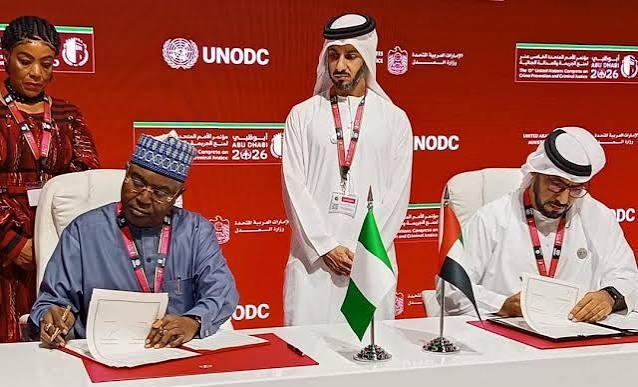
The Nigerian Association of Chambers of Commerce, Industry, Mines and Agriculture has hailed the Comprehensive Economic Partnership Agreement between Nigeria and the United Arab Emirates as a significant milestone in the country’s economic transformation journey.
The CEPA deal, recently signed by both countries, seeks to eliminate tariffs on over 7,000 products. Under the agreement, agricultural and industrial goods, including fish, seafood, oil seeds, cereals, cotton, pharmaceuticals, and chemicals, will enter the UAE market duty-free.
Over the next three to five years, the UAE is set to remove tariffs on Nigerian machinery, vehicles, electrical equipment, apparel, and furniture, while Nigeria will reciprocate by eliminating tariffs on roughly 6,000 products.
The signing took place during the 2026 Abu Dhabi Sustainability Week Summit, with Nigerian President Bola Tinubu and UAE President Mohamed bin Zayed Al Nahyan in attendance. Speaking on the occasion, President Tinubu described CEPA as “a historic and strategic agreement,” emphasizing that it will foster cooperation in aviation, logistics, agriculture, and climate-smart infrastructure.
Commenting on the agreement, NACCIMA said, “The Nigeria-UAE CEPA directly advances the objectives of the Renewed Hope Agenda by strengthening trade expansion, investment mobilisation, industrial growth, and private-sector-led productivity, which are central to Nigeria’s aspiration of achieving a $1 trillion economy by 2030.
“The agreement expands market access for Nigerian goods and services, improves investor confidence, and creates a predictable framework for increased capital inflows, value-chain integration, and enterprise development across priority sectors including manufacturing, agribusiness, services, infrastructure, finance, logistics, and the digital economy.
“The CEPA provides a robust platform for deepened collaboration between Nigerian businesses, UAE investors, and government institutions to scale production, boost exports, create jobs, and enhance competitiveness.
“The agreement further reinforces Nigeria’s strategic position as a preferred investment destination and as a gateway to the ECOWAS sub-region and the African Continental Free Trade Area (AfCFTA), thereby multiplying opportunities for regional and global market access.”