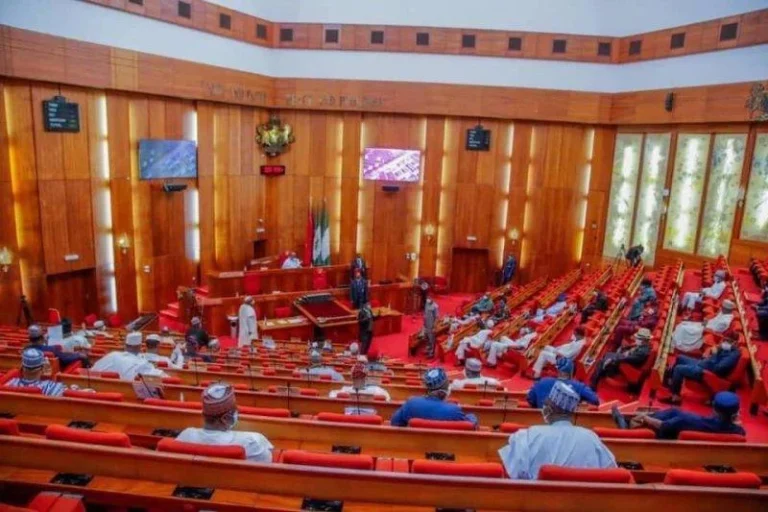
The Nigerian Senate on Tuesday suspended deliberations on a bill proposing a five-year jail term for individuals involved in supplying drugs or instruments used to procure abortions, citing confusion over the bill’s intent and language.
The bill, titled “Supplying Drugs or Instruments to Procure Abortion,” raised concerns among lawmakers during plenary, prompting calls for further legal scrutiny. A video clip from NASS TV captured the moment the Senate opted to refer the bill to its Committee on Judiciary, Human Rights, and Legal Matters for review.
Deputy Senate President, Barau Jibrin, initiated the motion to step down the bill and seek expert legal interpretation. His motion was seconded by Senator Orji Uzor Kalu (Abia North), who described the proposed legislation as vague and potentially problematic.
“In view of the confusion generated by the title and the interpretation that anyone taking or supplying any drug at all could face five years imprisonment, it is only fair that this bill be stepped down for clearer legal interpretation,” Kalu argued.
Senate President Godswill Akpabio, who presided over the session, agreed with the concerns and ruled that the bill be suspended pending further examination.
“The Deputy Senate President has proposed a motion that we step down further consideration of this bill and refer it to our Committee on Judiciary and Legal Matters to get back to us in two weeks,” Akpabio said.
“Distinguished Senator Orji Uzor Kalu, a strong leader and member of this Assembly, has seconded it,” he added before calling for a voice vote, which was carried by the “ayes.”
Shortly after the decision was adopted, Senator Natasha Akpoti-Uduaghan (Kogi Central) sought permission to address the Senate, noting the sensitive nature of abortion-related issues and their impact on women.
“Mr President, please may I speak? I am a woman, and abortion has to do with women,” she said.
However, her request was swiftly challenged by Senator Adams Oshiomhole (Edo North), who reminded the chamber of procedural rules that prohibit further discussion after a resolution has been passed.
“Once the gavel has been dropped, the rule is clear — no further discussion. If we start granting exceptions, then we will have no rules,” Oshiomhole cautioned.
President Akpabio upheld the objection, invoking Rule 52(6) of the Senate Standing Orders, which bars the reconsideration of concluded matters except through a formal motion for rescission.
“The matter has been stepped down in totality. Any further deliberation must follow due process,” Akpabio ruled.