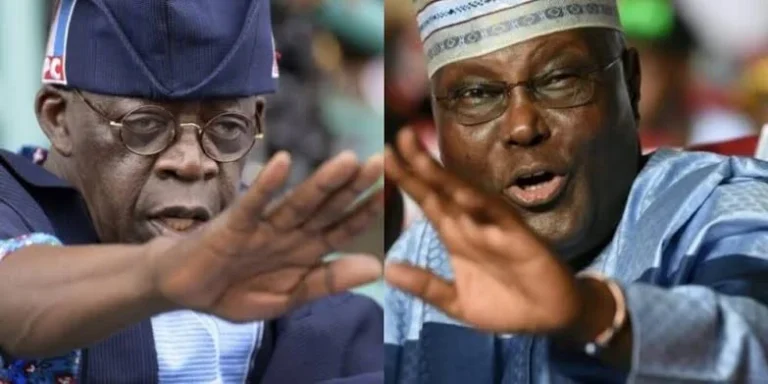
The political battle between former Vice President Atiku Abubakar and President Bola Tinubu has intensified, with the African Democratic Congress presidential candidate challenging the Federal Government to investigate and prosecute him if it has evidence connecting him to alleged financial wrongdoing in the power sector.
According to The Punch, Atiku, through his Senior Special Assistant on Public Communication, Phrank Shaibu, accused the Tinubu administration of reviving old allegations surrounding the $16bn power projects to divert attention from questions about how revenues saved from the removal of petrol subsidy have been spent.
The controversy dates back to the power-sector spending and commitments under the administration of former President Olusegun Obasanjo, which were investigated after his government left office in 2007. Atiku, who served as vice-president during that period, said he had repeatedly challenged successive governments to produce evidence of wrongdoing against him.
“The National Assembly investigated the power projects. I was never invited to answer any allegation of wrongdoing.
“Yes, I chaired the National Council on Privatisation as Vice President. But on the power project, I disagreed with its concept and did not preside over its implementation. The responsible minister did. The same applies to the Aluminium Smelter matter.
“I have repeatedly asked to be investigated. I left office in 2007 and have spent much of the period since then opposing governments in power. If there is evidence that I stole public money, why has no government produced it before a court?
“It is still not too late. Investigate me. Invite me. Produce the evidence. Prosecute me if you have a case. But propaganda cannot substitute for evidence,” the statement read in part.
Atiku also turned his attention to the economic consequences of Tinubu’s decision to remove petrol subsidy shortly after assuming office in May 2023.
He argued that Nigerians had endured higher petrol, transport and food prices on the understanding that savings from subsidy removal would be redirected to development, demanding greater transparency over the use of the funds.
“They removed subsidy from the poor and promised that the sacrifice would free resources for development. Nigerians accepted extraordinary pain on that promise. Today, petrol is more expensive, transportation is more expensive, food is more expensive, and the purchasing power of the Nigerian worker has been devastated,” he added.
He further questioned government spending and incentives granted to major economic interests, asking what had become of the increased government revenue generated since subsidy removal.
“Meanwhile, government revenues have increased, while fiscal incentives, waivers, tax credits and concessions continue to be available to powerful economic interests. So, our question remains brutally simple: where is the people’s money?”
Atiku maintained that government could not withdraw relief from ordinary Nigerians in the name of fiscal sustainability while defending interventions benefiting influential economic players as necessary incentives.
“You cannot take relief away from the poor, celebrate the resulting revenue and then tell the same impoverished citizens that government intervention on their behalf is economically irresponsible while interventions benefiting powerful interests are called incentives. That hypocrisy is precisely what we are challenging,” he stressed.
The former vice-president also dismissed attacks against him as politically motivated, insisting that allegations that had remained unresolved for nearly two decades should not be used to silence his demand for accountability.
“The people who removed subsidy from the poor cannot frighten us into silence by resurrecting allegations that governments with all the investigative machinery of the Nigerian state have had nearly two decades to establish,” he said.
“If you have evidence against Atiku, bring it. If you have a case, prosecute it. But if you have neither, stop manufacturing distractions and answer Nigerians. You removed the subsidy. You collected the savings. Where is the money?”
Presidency attacks Atiku’s subsidy position
The Presidency, however, accused Atiku of repeatedly changing his position on petrol subsidy and described his proposals as contradictory.
The Special Adviser to the President on Information and Strategy, Bayo Onanuga, said in a statement titled, “Atiku confused on petrol subsidy; third U-turn in one week shows he is simply playing politics,” that the former vice-president and his aides had offered different explanations of his proposed subsidy policy.
Onanuga said Atiku’s spokesperson, Paul Ibe, initially indicated that the former vice-president would restore petrol subsidy if elected and later phase it out.
He said Phrank Shaibu subsequently rejected that explanation as an “unauthorised and misleading characterisation,” saying subsidy would remain until domestic refining increased, supply stabilised and competition improved.
According to Onanuga, Atiku later reaffirmed that he would restore what he called a targeted subsidy.
He quoted Atiku as saying, “I will restore targeted subsidy and put purchasing power back in the hands of Nigerians.”
Onanuga challenged the ADC candidate to explain the proposed arrangement, including its cost, beneficiaries, funding source and conditions for ending it.
“We therefore urge Atiku to stop shifting positions and explain precisely what he means by ‘targeted subsidy’: how much will it cost, who will benefit, how will beneficiaries be identified, how will it be funded and what objective economic conditions will determine its eventual termination?” he asked.
The presidential aide also argued that petrol prices were only one of several factors affecting Nigerians’ cost of living, citing insecurity, exchange rates, logistics, storage, flooding and agricultural input costs.
He questioned why Atiku’s proposed intervention should focus only on petrol when crude oil refining produces several other products, including diesel, aviation fuel and kerosene.
Onanuga further recalled that diesel was deregulated in 2004 under the administration in which Atiku served as vice-president, while kerosene and aviation fuel were deregulated at different times.
The Presidency accused Atiku of failing to provide a comprehensive response to the wider economic challenges facing Nigerians and described his proposed subsidy policy as inconsistent.
APC challenges Atiku to court
The ruling All Progressives Congress also joined the criticism, challenging Atiku to take his allegations to court if he had evidence that “thieves” were responsible for the country’s political and economic problems.
The APC reaction followed remarks attributed to Atiku during an address to supporters in Abuja, where he reportedly said the 2027 election would be a contest against people who had stolen the country’s election and economy.
The APC Director of Publicity, Bala Ibrahim, urged Atiku to seek legal redress if he could substantiate the allegations.
“As a former Vice President of the country and as someone who has contested elections and lost before, I don’t know if Atiku is passing a vote of no confidence on the judiciary. If he is, then he has no business contesting again. ‘’But if he has confidence in the judiciary and he is making these allegations, I think he knows the right place to go, to prove his point. He should go to court, present facts to support his claims that he is competing against thieves. It is for the court to take a decision and those thieves will certainly be made to have their day in court,” he said.
NANS opposes subsidy return
Meanwhile, the National Association of Nigerian Students criticised Atiku’s promise to restore fuel subsidy, describing it as a political response to economic hardship rather than a lasting solution to Nigeria’s fiscal problems.
NANS President Akinteye Babatunde argued that the previous subsidy regime had become financially unsustainable, encouraged smuggling and consumed substantial public resources.
“Every sane and patriotic citizen who is conversant with our nation’s economy will agree with me that the removal of the fuel subsidy was a difficult but necessary economic reform aimed at ending an increasingly unsustainable system that consumed trillions of naira, benefited higher fuel consumers disproportionately, encouraged smuggling, and constrained the government’s ability to invest in critical sectors.”
He said the effectiveness of subsidy removal should ultimately be judged by how the savings are deployed.
“However, the real measure of the reform should not be the savings alone, but what the government does with those savings,” he said.
“Clearly, we have seen the government increase state subventions and redirect resources into education, healthcare, infrastructure and agriculture. Realistically, the Nigerian people have made a productive sacrifice that must ultimately translate into a stronger and more sustainable economy,” he said.
Babatunde warned that simply restoring the old subsidy arrangement without addressing its structural weaknesses could recreate the same problems that led to its removal.
“This is why calls or promises for the outright return of subsidy, without a clear structural framework for addressing the fundamental weaknesses that made the policy unsustainable in the first place, amount to little more than a political response to a genuine economic challenge.”