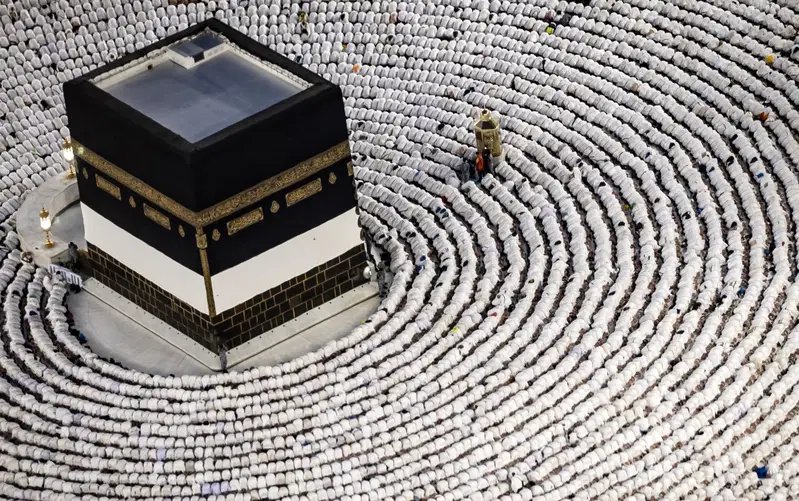
The National Hajj Commission of Nigeria has issued fresh operational guidelines for the 2026 Hajj, introducing tighter rules on flight schedules, medical fitness, data management and pilgrim grouping.
The new directives were announced in a statement titled “NAHCON Directs Airlines to Issue 2026 Hajj Tickets Ahead of Departure”, released on December 4, 2025, after a meeting with State Pilgrims’ Welfare Boards and accredited airlines at the commission’s headquarters in Abuja.
The press release, signed by the Deputy Director of Information and Public Relations, Fatima Sanda Usara, stressed that all approved Hajj carriers, working with state boards, must ensure pilgrims receive their flight tickets before departure.
According to the statement, this will guarantee that each pilgrim “is fully aware of his or her exact departure schedule, including the date, time, and airport of departure.”
NAHCON explained that the new measure aims to drastically reduce the recurring problem of inaccurate pre-arrival data transmitted to Saudi Arabia, which often disrupts the issuance of the mandatory Nusuk cards and other logistics.
A major policy shift is the commission’s declaration that missing a flight for the 2026 Hajj will carry “grave consequences.” NAHCON noted that every pilgrim’s flight ticket will be digitally linked to their Nusuk Card, which will be placed in their designated buses in Saudi Arabia.
“Beginning with the 2026 Hajj, pilgrims who miss their flights will be considered defaulters and may bear the cost of the unused seat,” the statement warned.
The commission also announced that pilgrims will no longer be allowed to switch groups after visas have been issued. Each group will consist of 45 pilgrims, who will travel, lodge, and return to Nigeria together under a designated group leader.
Their accommodation arrangements in Makkah, Madinah and the Masha’ir areas will also be tied strictly to their group identity.
NAHCON further stated, “Pre-arrival data must be uploaded on the Nusuk Masar platform 72 hours before any aircraft departs with pilgrims.” Required information includes group numbers, names of members, accommodation details and bed-space numbers.
The Ministry of Hajj and Umrah has introduced a compulsory boarding card for all pilgrims.
The card will display details such as the airline’s name and capacity, state of origin, number of pilgrims, departure and arrival airports, and travel timelines.
While confirming that camp booking and other logistical arrangements have been completed, NAHCON warned that Saudi authorities will return any excess payments if accommodation allocations do not match the submitted records, automatically causing the affected slots to be forfeited.
State boards were therefore advised to remit Hajj fares promptly to avoid losing more spaces.
The commission reiterated its commitment to enforcing Saudi Arabia’s new medical fitness rules. According to the Ministry of Hajj and Umrah, pilgrims with any of nine disqualifying medical conditions are barred from performing Hajj and will bear the full cost of deportation if they travel.
These conditions include major organ failures—heart, liver, kidney or lungs—cancer patients undergoing treatment, severe psychiatric or neurological disorders, dementia, high-risk pregnancies, and active infectious diseases.
NAHCON directed state boards to collaborate only with accredited hospitals when issuing medical fitness certificates.
The commission listed the approved carriers for the 2026 pilgrimage as Air Peace, Fly Nas, Max Air, and Umza Air, adding that allocations may still change due to technical considerations.
NAHCON Chairman, Professor Abdullahi Saleh Usman, called for unity among all stakeholders involved in the Hajj operations. “The success of NAHCON is the success of every stakeholder,” he said, urging state boards and airlines to work together to ensure a seamless pilgrimage.