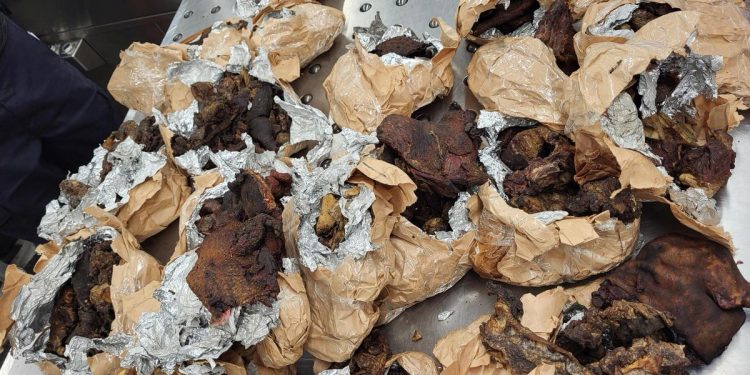
The United States Customs and Border Protection has issued a warning to international travellers, stressing that bushmeat is strictly banned from being brought into the United States under federal import regulations designed to safeguard public health, safety, and the country’s agriculture and wildlife.
In an advisory to passengers arriving from overseas, the agency urged travellers to carefully check its list of restricted and prohibited goods before departure to avoid penalties, confiscation of items, or other enforcement actions at ports of entry.
Bushmeat, defined as meat derived from wild animals hunted in regions including parts of Africa, is explicitly prohibited under U.S. import laws.
CBP enforces this rule in coordination with agencies such as the U.S. Fish and Wildlife Service, the U.S. Department of Agriculture, and the Centers for Disease Control and Prevention.
The agency explained that prohibited items are those considered dangerous to public health, safety, workers, or ecosystems, or those deemed inconsistent with national regulations and interests.
“Sometimes the products that cause injury, or have the potential to do so, may seem fairly innocent. But, as you will see from the material that follows, appearances can be deceiving,” the agency said in its advisory.
CBP further warned that bushmeat has been associated with serious health risks, including the transmission of diseases such as Ebola, and could also threaten U.S. agriculture by introducing foreign animal diseases capable of devastating livestock populations.
It noted that while prohibited items are completely barred from entry, restricted items may be allowed only with special permits issued by relevant federal authorities.
Among prohibited goods listed by the agency are bushmeat, unsafe toys, certain hazardous vehicles, and illegal substances such as absinthe and Rohypnol.
Restricted items, on the other hand, include firearms, selected fruits and vegetables, animal products, and some live animals.
CBP advised travellers to review official guidelines before international trips, emphasizing that its officers at ports of entry enforce hundreds of federal laws on behalf of multiple agencies.
Travellers who attempt to bring bushmeat into the United States risk confiscation of the items and possible legal penalties.
The warning is especially relevant for travellers from West African countries, where bushmeat consumption is more common and may occasionally be carried for personal or cultural reasons.
The agency reiterated that passengers entering the United States should confirm what items are allowed before travelling, noting that enforcement remains strict at all ports of entry.