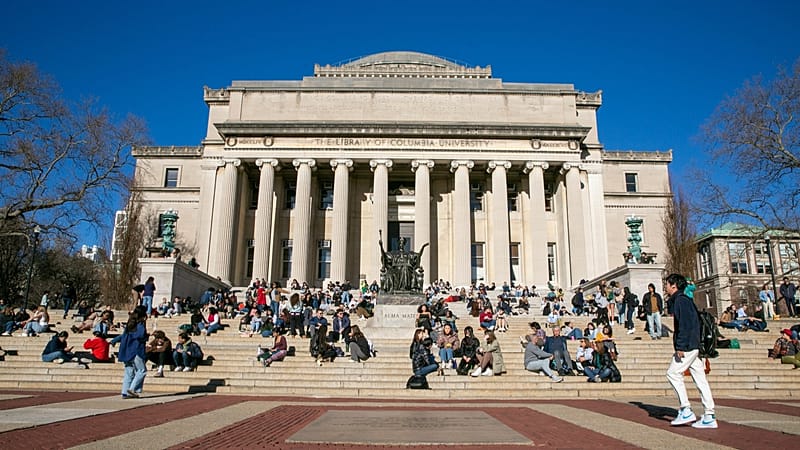
International student enrolment in universities across the United States has fallen by nine per cent amid tighter immigration policies and changes to the country’s higher education system under President Donald Trump.
A survey released on Monday by the Institute of International Education showed that the number of international students on US campuses dropped by nine per cent this autumn compared with the same period last year.
The number of new international students arriving in the country also declined by 15 per cent.
“No one aspires to send their kids to get educated in the US,” said Veena Dubal, general counsel for the American Association of University Professors, whose father travelled from India to attend Tuskegee University, formerly known as Tuskegee Institute, in the late 1960s on a student visa.
“It feels like an unsafe place. That’s the message that the Trump administration has been sending to families all over the world and they’re listening.”
The decline comes amid increased immigration restrictions, including measures targeting international students and their opportunities to remain in the country after graduation.
The Department of Homeland Security has proposed a $70,000 fee for every student participating in the Optional Practical Training programme, which allows foreign graduates to gain temporary work experience in the US.
Although the proposal is yet to be finalised, participation in the programme fell by six per cent this autumn.
The administration has also moved to terminate the legal status of thousands of international students, while some have faced detention and deportation.
A separate rule limiting international students’ stay in the country to four years without federal approval was finalised this summer but has been temporarily blocked by a judge.
Despite remaining the world’s leading destination for international students, the US is facing growing competition from other countries.
A survey of more than 800 American colleges and universities found that 88 per cent blamed visa application procedures for the decline in enrolment, while 70 per cent cited travel restrictions.
The report also indicated that 95 per cent of the institutions surveyed believed international students would consider other countries if opportunities under the OPT programme were restricted.
Rising tuition costs, global competition and uncertainty surrounding research funding were also identified as factors influencing students’ decisions.
Fanta Aw, executive director and chief executive officer of NAFSA, an association representing international education, said concerns about the US research funding system were contributing to the uncertainty among prospective students.
“They’re saying to themselves, ‘Too much uncertainty in the United States. It’s too difficult, and you know, more importantly, we have many more choices today than we did 10 years ago. Why subject ourselves to this?’” Aw said, noting that students are going to places like China.
The decline is also affecting the American economy.
NAFSA, working with international education technology company JB International, estimated that international students’ economic contributions to the US fell by $2.4bn this autumn.
Several universities are already experiencing financial difficulties as a result of the reduced enrolment.
Cleveland State University, for instance, recorded a 46 per cent decline in its international student population over two years, falling from 1,542 in autumn 2025 to 828 this year.
The university’s provost, Nigamanth Sridhar, said fewer than 50 new international students enrolled this autumn, estimating that the decline could cost the institution between $2m and $4m.
Sridhar, who moved to the US from India on an F-1 student visa before participating in the OPT programme and eventually becoming a naturalised citizen, said his personal experience demonstrated the importance of international education.
“I am here in this position, in this job, because I had the opportunity to come to the United States as an international graduate student and then decided to stay here and build a career,” said Sridhar, who is from India. “So international education is personal to me.”
The survey further revealed that postgraduate enrolment experienced the sharpest decline, dropping by 15 per cent, compared with a three per cent reduction among undergraduate students.
Enrolment from India, the largest source of international students in the US, also recorded a decrease.
Meanwhile, Sarah Spreitzer, vice president of the American Council on Education, said significant immigration legislation was unlikely while Trump remained in office.
However, she expressed hope that congressional oversight could prevent sudden policy changes affecting international students and provide greater certainty for those considering studying in the country.