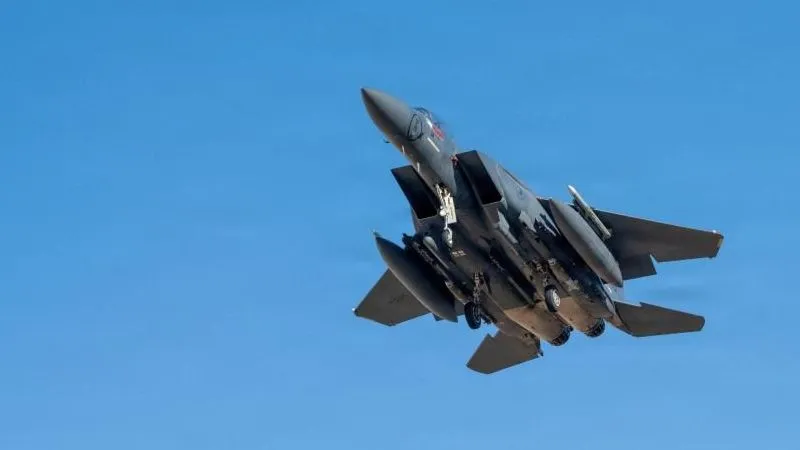
A US Air Force airman rescued from Iran after his F-15E fighter jet was shot down in April has recounted how he survived the crash, evaded Iranian forces and waited 50 hours before American rescuers reached him.
The airman, identified only by the call sign “Bravo” during a “60 Minutes” interview on Sunday, said his parachute was damaged after the aircraft was hit.
He said he struggled during the free fall to “unfurl or pull pieces of the parachute loose.”
“It was the most terrifying thing I’ve ever seen,” he said, adding that the fall left him with a broken back, arm and shoulder, as well as a sprained ankle and injuries to his head and face.
After ejecting from the F-15, the weapon systems officer avoided detection by Iranian forces and climbed a 7,000-foot ridge despite his injuries.
He had only a pistol, a communication device and a tracking beacon, according to previous accounts from US officials and his own description of the ordeal.
While the aircraft’s pilot was rescued shortly after the crash, “Bravo” remained alone for another 50 hours before American forces located him.
The Pentagon has not publicly identified either crew member, citing security concerns and the need to protect sensitive information.
“As soon as I found a spot that I felt provided some concealment, I started working toward communication,” “Bravo” told CBS’ Norah O’Donnell.
Recalling the first message he sent after getting into a position where he could communicate, he said, “God is good.”
The rescue operation involved hundreds of US military and intelligence personnel, including Army Delta Force and Navy SEAL Team Six.
American aircraft also carried out strikes to clear the area, while CIA operatives had earlier conducted a deception campaign aimed at preventing Iranian authorities from locating the downed airman.
Declassified Pentagon footage shown during the CBS programme captured US Air Force pararescue operators moving towards “Bravo” on the mountain. He declined to reveal what the rescuers told him when they eventually reached him.
The operation also suffered setbacks after two damaged MC-130J special operations transport aircraft were destroyed because they could not safely be recovered and there were concerns they could fall into Iranian hands.
More than 90 special operations personnel were temporarily stranded before being evacuated and replacement aircraft were sent in.
Reflecting on the moment he saw his rescuers approaching along the ridge, “Bravo” said it “was one of the greatest moments of my life, and I don’t know how to say it any more clearly than ‘thank you’ for all that they did.”