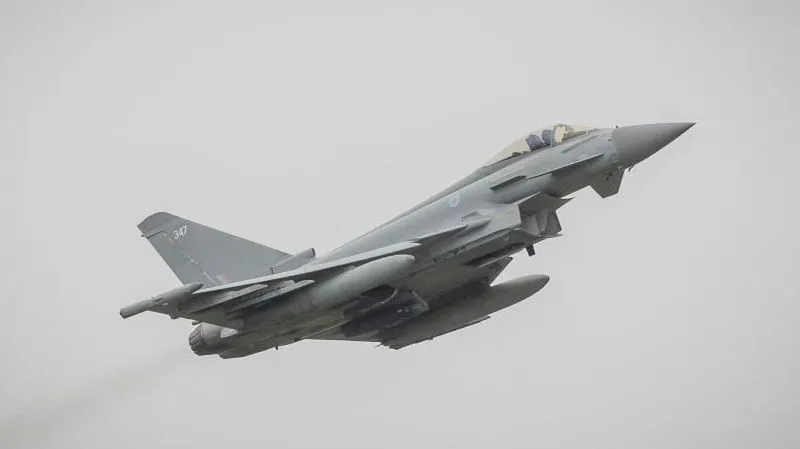
The United Kingdom will deploy Royal Air Force Typhoon fighter jets to Saudi Arabia to strengthen the kingdom’s air defences against escalating missile and drone attacks by Yemen’s Houthi rebels.
The deployment, authorised by Prime Minister Andy Burnham, is intended to protect Saudi cities and critical infrastructure from further attacks by the Iran-backed group.
Defence Secretary Wes Streeting said the British aircraft would operate strictly in a defensive capacity.
“These aircraft will operate in a defensive role and will not conduct offensive strikes against the Houthis,” Streeting said in a written statement on Tuesday.
The decision follows a series of Houthi attacks targeting Saudi Arabia, including strikes on the capital, Riyadh, and energy facilities along the country’s coast.
The Houthis have been fighting Yemen’s internationally recognised government, which is backed by Saudi Arabia.
The group seized control of the capital, Sanaa, in 2014, triggering years of conflict.
Tensions have escalated since September, following the breakdown of a fragile ceasefire in Yemen.
The Houthis launched a renewed offensive against government forces and established effective control over the strategically important Bab al-Mandab Strait.
Government forces, supported by Saudi air power, subsequently launched a counter-offensive, prompting the Houthis to intensify attacks on targets inside Saudi territory.
The attacks have reportedly hit key infrastructure, including King Khalid airport, energy facilities and major ports.
Saudi authorities said last week that 19 people had been killed in Houthi attacks on the kingdom’s airports.
One of the deadliest incidents occurred on 10 October, when a missile struck Riyadh’s international airport, killing 13 people and injuring 308 others.
The attack was described as Saudi Arabia’s deadliest in more than a decade.
The Houthis have said their attacks are retaliation for strikes against areas under their control in western Yemen, including Sanaa.
The violence has also intensified within Yemen.
More than 70 security personnel were reportedly killed earlier this week when a Houthi missile struck a military camp in the central province of Shabwa.
A spokesman for the Saudi-backed Yemeni armed forces said the group fired three ballistic missiles at al-Alam camp near Ataq.
The Houthis’ military spokesman said the operation targeted “Saudi enemy concentrations”.
According to the Houthi-run health ministry in north-western Yemen, Saudi air and artillery strikes have killed at least 141 people and injured 395 since 3 September.
Meanwhile, Yemen’s internationally recognised government said last week that at least 1,282 people had died in the wider conflict across the country since 6 August.
Saudi Arabia has faced difficulties intercepting incoming missiles and drones, partly because much of its air defence capacity was deployed against Iranian attacks earlier this year.
The kingdom’s vast geographical size has also complicated efforts to protect its airspace effectively.
The deployment of British fighter jets is expected to reinforce Saudi Arabia’s defensive capabilities while allowing its own aircraft to be redirected towards offensive operations against the Houthis.
In addition to the Typhoons, the UK will send military advisers and an RAF A400M transport aircraft to assist with moving defence equipment within Saudi Arabia.
Britain is already supplying the kingdom with equipment to counter aerial attacks and providing air-to-air refuelling support for defensive Saudi military operations.
The refuelling arrangement has now been extended by 90 days.
In a separate statement, Streeting said the attack on Riyadh airport demonstrated the scale of the Houthis’ escalation.
“That’s why today I have approved further UK military support,” the defence secretary added.
He also warned that the violence in the Gulf was disrupting energy supplies and driving up costs for households and businesses.
Earlier this month, Houthi military spokesman Brig Gen Yahya Saree vowed that the group would continue its attacks inside Saudi Arabia.
The British deployment comes amid growing concerns over the widening regional conflict and the threat posed by continued Houthi missile and drone strikes to Saudi Arabia’s population, infrastructure and energy facilities.