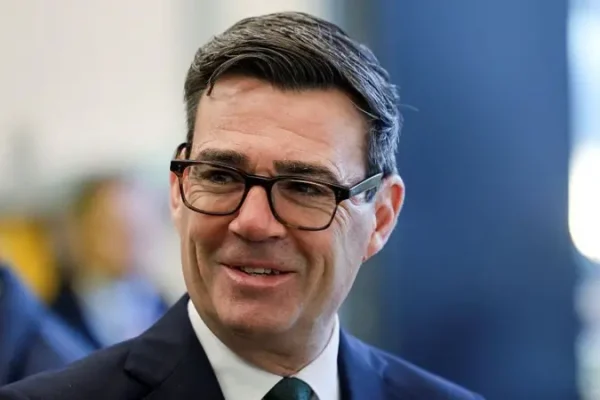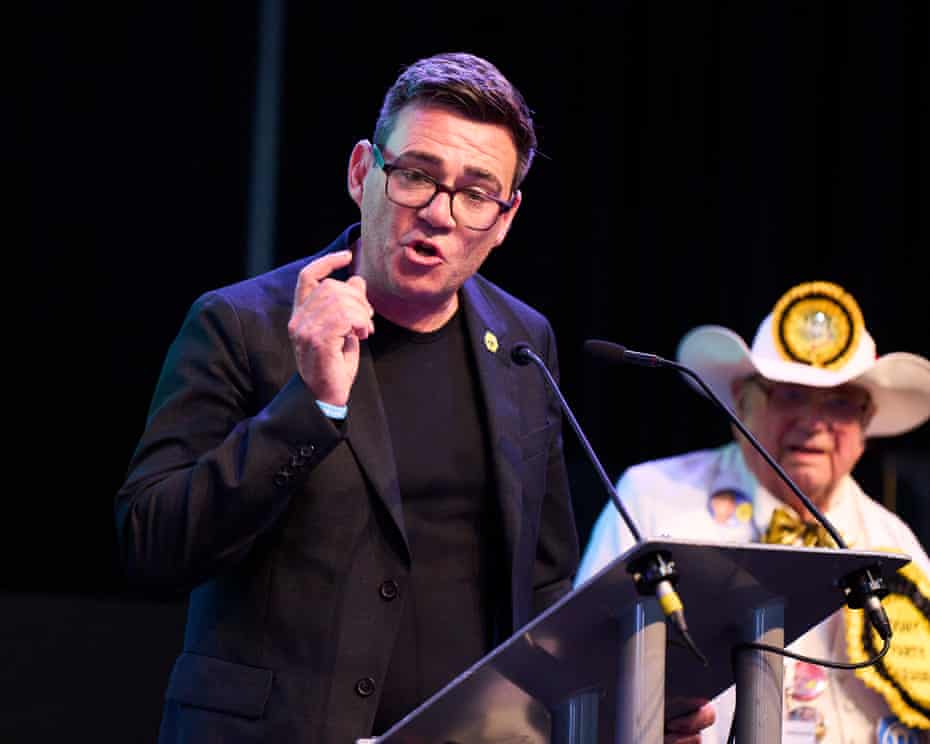
United Kingdom politician, Andy Burnham, is now positioned as a potential challenger to British Prime Minister Keir Starmer after winning a resounding victory in the by-election for Makerfield, a result that could reshape the leadership direction of the governing Labour Party.
The by-election, held on Thursday and comparable to a special election in the United States, was engineered to create a pathway for Burnham’s return to Westminster and a possible route to Downing Street.
Burnham, already serving as Mayor of Greater Manchester and widely regarded as one of Labour’s most influential figures, has long been seen as a possible rival to Starmer.
By early Friday morning, with all ballots counted, Burnham had secured a commanding 55% share of the vote. He comfortably defeated Robert Kenyon of the right-wing populist Robert Kenyon, who finished second with 35%.
The result immediately injected uncertainty into UK politics, with speculation growing over Burnham’s next political move.
“Everyone knows that politics isn’t working. Everyone can feel that the country isn’t where it should be. Tonight could just be the turning point,” Burnham said after results were announced, adding that it was a “chance to build a new politics built on unity and hope, turning away from the path that takes us to a divided, dark politics of the kind we see in the United States.”
“This result will bring about a country that works fairly for everywhere and for everybody,” he said.
A former cabinet minister and long-serving mayor, Burnham now returns to Parliament at a critical moment for Labour. The party swept to power in 2024 after 14 years in opposition, but its popularity has since fallen sharply.
That decline culminated in heavy losses in May local elections, where Reform UK made significant gains.
Pressure within Labour has mounted, with some MPs calling for Starmer to step down. However, Burnham has been unable to mount a formal leadership challenge while outside Parliament, as party rules require leaders to be sitting MPs.
The party leader also automatically becomes prime minister if they command a parliamentary majority, without a general election.
On May 14, Labour MP for Makerfield Josh Simons announced he would vacate his seat “so that Andy Burnham can return to his home, fight to re-enter Parliament, and if elected, drive the change our country is crying out for.” Labour’s National Executive Committee later approved Burnham’s candidacy after previously blocking similar efforts.
For five weeks, Makerfield, a collection of former coal-mining communities near Manchester, became the focal point of British politics. With roughly 75,000 voters, the constituency attracted intense national and international attention, effectively becoming a test case for the country’s political direction.
Burnham’s main opponent was not the Conservative Party but Robert Kenyon, a 41-year-old plumber representing Reform UK. Kenyon campaigned on economic frustration and immigration concerns, repeatedly arguing that Burnham was using the seat as a “stepping stone.”
In his victory remarks, Burnham insisted Makerfield would not serve personal ambition, saying it would instead become a symbol of accountability.
“Makerfield will never be a stepping stone to me, but instead will be my touchstone” that would stand as a “test at the heart of British politics” to “ensure that the places Westminster has neglected will now get fairness.”
Observers noted that Burnham carefully avoided framing the contest around his leadership ambitions during the campaign, focusing instead on local issues while keeping party politics in the background.
“Andy Burnham has managed to not let the national picture and his national ambitions dominate the by-election there,” said Patrick English, head of elections and political and social data at YouGov. He added that Burnham’s “outsider perspective” helped him in a seat that Reform “should absolutely walk” in a general election.
Economic decline linked to deindustrialisation, including the closure of coal mines in the 1980s, has long shaped Makerfield’s fortunes. That legacy has collided with rising living costs and immigration concerns, producing a volatile political climate in a constituency that has voted Labour for more than a century.
Reform UK’s influence has been growing steadily. In the 2016 Brexit referendum, 65% of voters in Makerfield supported leaving the European Union, compared with a national figure of 51.8%.
In the 2024 general election, Kenyon previously secured 32% of the vote, while Reform went on to dominate recent local council elections in the area, leaving Labour without a single councillor.
Local voter Stephen Burrows, a former builder, told CNN before the vote that immigration was a key issue driving his support for Reform, dismissing official migration data as irrelevant to his lived experience.
“They’re everywhere. Why are there riots in Scotland and Liverpool and Ireland? Because people don’t want it, but it’s been (imposed) on people,” he said, referring to recent incidents of race-related unrest linked to high-profile crimes.
Two days before polling day, local teacher and Christian evangelist Paul Sparks conducted an informal street poll in Ashton-in-Makerfield, using columns for Labour, Reform UK and Restore Britain. “The majority of people want change,” he told CNN. “We’re at a tipping point, we really are, and if things don’t change very soon, we’re going to see things getting a lot worse.”
That sentiment was echoed by Burnham after his win. “When this borough went to the polls in May, it made a loud cry for change,” he told supporters.
“In this campaign, we have begun to answer that, but I do say to my own party, this is a final chance to change.”