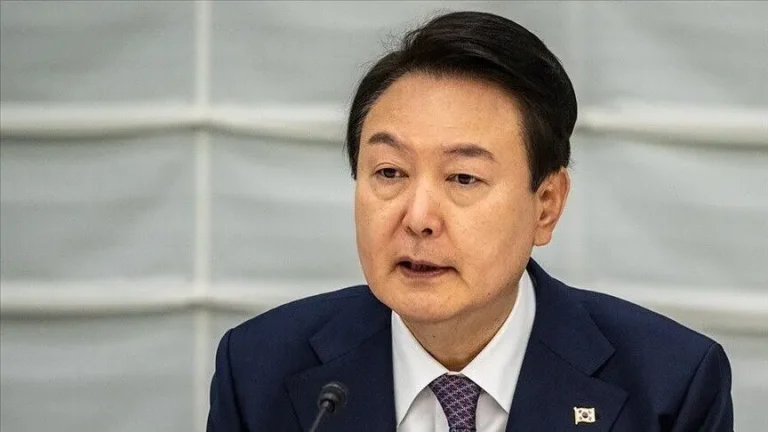
South Korean President, Lee Jae Myung, has called for direct discussions with North Korea aimed at formally bringing an end to the Korean War, which has remained unresolved for more than seven decades.
Lee made the proposal on Friday during a ceremony commemorating Korea’s liberation from Japanese colonial rule, as tensions continue to rise on the Korean Peninsula and Pyongyang strengthens its relationship with Russia.
The 1950-53 Korean War ended with an armistice rather than a peace agreement, leaving the two countries technically at war.
“Let us put down our intentions to threaten each other and begin discussions to end the long-running war as the directly involved parties,” Lee said in his speech.
“Through this, it may also be possible to discuss effective measures to halt the advancement of North Korea’s nuclear capabilities,” he added.
The South Korean president’s proposal comes amid renewed tensions over the annual military exercises conducted by the United States and South Korea.
North Korea has condemned the drills and threatened to strengthen its military deterrence in response.
Pyongyang has also criticised Japan’s growing defence capabilities in the Pacific.
North Korea has launched two missiles in recent weeks following Tokyo’s pledge to accelerate its military build-up in response to what it described as an increasingly serious security environment.
North Korea has maintained that its status as a nuclear-armed country is irreversible, a position it has repeatedly asserted since the collapse of the 2019 summit between its leader, Kim Jong Un, and then-US President Donald Trump in Hanoi.
The summit ended without an agreement on denuclearisation or sanctions relief.
Since assuming office in June 2025, Lee has adopted a more conciliatory approach towards Pyongyang than his predecessor, offering dialogue without preconditions.
In July, South Korea’s unification minister said Seoul had shifted away from prioritising pressure on North Korea to abandon its nuclear weapons programme, instead focusing on measures to prevent further expansion of its nuclear capabilities.
North Korea has yet to respond positively to Lee’s repeated calls for dialogue and has instead expanded its military cooperation with Russia.
Analysts say Pyongyang has received financial assistance, food, energy and military technology from Moscow in exchange for providing troops and ammunition for Russia’s war in Ukraine.
Kim is also expected to travel to Russia later this year, with further military cooperation potentially featuring in discussions between the two leaders.
The United States, South Korea’s main security ally, has about 28,500 troops stationed in the country to support its defence against potential threats from North Korea.
Colonel Ryan Donald, spokesman for the US and South Korean Combined Forces Command, said North Korea’s involvement in the war in Europe had altered the potential threat facing troops on the Korean Peninsula.
“They’ve taken those lessons they learned there and brought them back to North Korea,” he told reporters as he discussed the 11-day joint US-South Korean military exercises scheduled to begin on Monday.
“Our training accounts for that threat.”