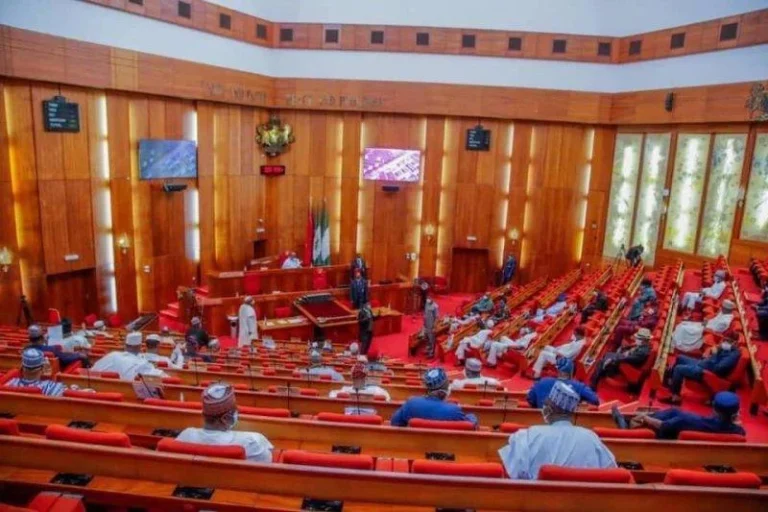
Pressure intensified on the National Assembly ahead of today’s harmonisation of the Electoral Act amendment bill, as protests, legal warnings, and expert disagreements heightened debate over mandatory real-time electronic transmission of election results before the 2027 polls.
Former Labour Party presidential candidate Peter Obi, activist Aisha Yesufu, and civil society groups staged a protest at the National Assembly, demanding that results be transmitted directly from polling units to the INEC Result Viewing portal.
Prevented from entering the complex by security operatives, the protesters insisted lawmakers retain provisions for real-time transmission.
The Senate is meeting the House of Representatives to reconcile differences in their versions of the amendment. While the House supports mandatory real-time transmission, the Senate adopted conditional transmission, sparking public criticism.
Civil society groups, legal experts, and election observers warned that ambiguity could undermine electoral credibility and fuel post-election disputes.
Former Enugu State REC, Dr Emeka Ononamadu, backed mandatory transmission, arguing INEC has the technical capacity. “I was shocked that in the 21st century, some 21st century senators were saying no to mandatory transmission,” he said, noting that network coverage and successful BVAS deployment make nationwide implementation feasible.
Contrastingly, Mr Lawrence Oyekanmi, spokesman for former INEC Chairman Prof Mahmood Yakubu, doubted feasibility.
“Many Nigerians are confusing the seamless display of PU results with real-time transmission of results,” he said, noting that electronic voting and collation are not yet legally or technically possible.
He recommended retaining 2022 Electoral Act provisions, warning that mandatory real-time transmission cannot be implemented for 2027.
Addressing journalists, Obi said, “That message is clear: let us have a transparent election process. We are not asking for much; it is something simple. It is for their own future and for the future of their children.” Civil society leaders reiterated that the bill must not be diluted, warning of further protests if lawmakers fail to act.
The Nigerian Guild of Editors urged the National Assembly to adopt mandatory and immediate electronic transmission, warning that ambiguity undermines public trust and could discourage voter participation.
“Nigerians are watching the National Assembly closely on this issue,” the Guild said.
Prominent lawyers Dr Olisa Agbakoba and SAN Ebun-Olu Adegboruwa also called for explicit statutory backing for electronic transmission.
Agbakoba noted that the Supreme Court ruled IReV lacked legal force in 2023 because it was not in the Electoral Act. “Without explicit statutory provision, electronic transmission remains optional and legally inconsequential,” he said.
Adegboruwa added, “The pathway to achieving transparency in our electoral process is to reduce human intervention in determining election outcomes.”