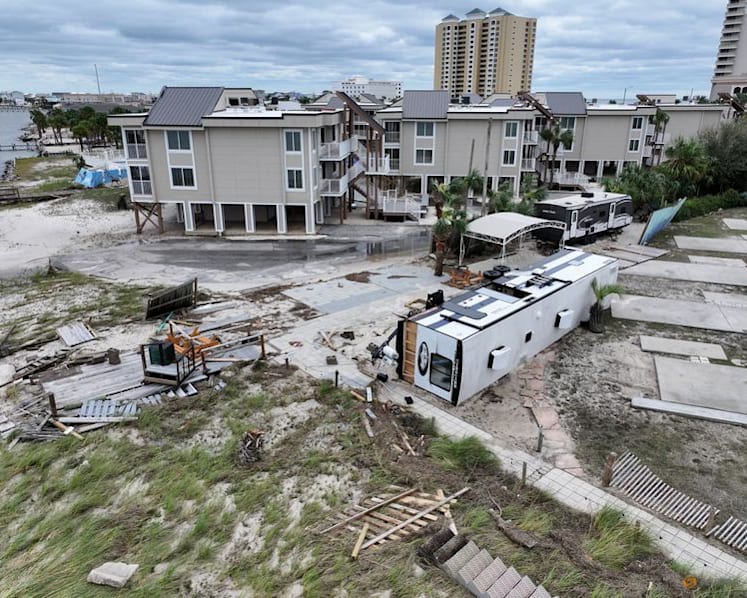
At least four people have died and about 670,000 residents have been left without electricity in the United States after Hurricane Isaias struck Florida before weakening into a post-tropical cyclone.
The storm, which made landfall early on Saturday as a Category 2 hurricane, affected Florida, Alabama, Georgia and Mississippi, with two of the reported deaths linked to trees falling on homes, according to local media and authorities.
Despite the storm’s weakening, the National Hurricane Center warned of continued hazards, including storm surges, flash floods, damaging winds and possible tornadoes across parts of the southeastern US.
The tornado threat was expected to persist in parts of Florida’s Panhandle, Georgia and the Carolinas.
Florida Governor Ron DeSantis said authorities had received no search and rescue requests shortly after the hurricane made landfall, suggesting that its immediate impact had been limited.
However, he cautioned residents about dangers that could persist after the storm.
Power restoration remained a priority as emergency crews assessed the damage and transportation services gradually resumed.
About 420,000 customers in Florida, 190,000 in Alabama, 43,000 in Georgia and 17,000 in Mississippi were without electricity by midday Saturday, according to PowerOutage.us.
“They’re going to make assessments this morning, and I think that’ll give us a good sense about the future for the rapidity of the power restoration,” DeSantis said at a press conference in Tallahassee, adding that about 16,000 utility linemen had prepared to respond to the storm.
Several roads and bridges were reopening, although hazardous conditions persisted in some areas.
Alabama’s emergency management agency warned that fallen trees and power lines had made travelling dangerous in Houston County, where a flash flood warning was in effect.
All roads in the county were closed until further notice.
In Pensacola, Florida, residents faced water supply challenges, while the city’s airport, the state’s 10th largest, sustained damage and remained closed to commercial flights until further notice.
The hurricane also disrupted oil and gas operations in the Gulf of Mexico.
Energy companies Shell and Chevron began redeploying personnel to their offshore facilities as they worked towards restoring production.
Shell said it was redeploying staff to its Mars, Olympus, Ursa, Vito and Appomattox assets, while Chevron was advancing efforts to return workers to its platforms and resume full production.
“Remobilization of crews will continue through Sunday,” Chevron said.
Despite the gradual resumption of operations, about 69 per cent of oil output and 57 per cent of natural gas production in the US Gulf of Mexico remained shut on Saturday, according to the Marine Minerals Administration.
Some 113 production platforms, representing 30 per cent of the total, were still evacuated.
Meanwhile, the US Energy Department authorised the emergency release of up to four million barrels of crude oil from the Strategic Petroleum Reserve to help address supply disruptions caused by the hurricane.
US President Donald Trump had described preparations for the storm as “under control” when questioned by reporters outside the White House on Friday.
Emergency declarations were also approved in Florida and Alabama to ensure federal assistance could be made available to affected communities.
“There’s also a lot of hazards post-storm that people should be careful of, but so far, we’ve had a lot of assets in place that have not been called on,” DeSantis told Fox News early on Saturday.