The Federal Government has introduced a ₦50 million Student Venture Capital Grant (S-VCG) to boost innovation, research excellence and entrepreneurship among students in Nigeria’s tertiary institutions.
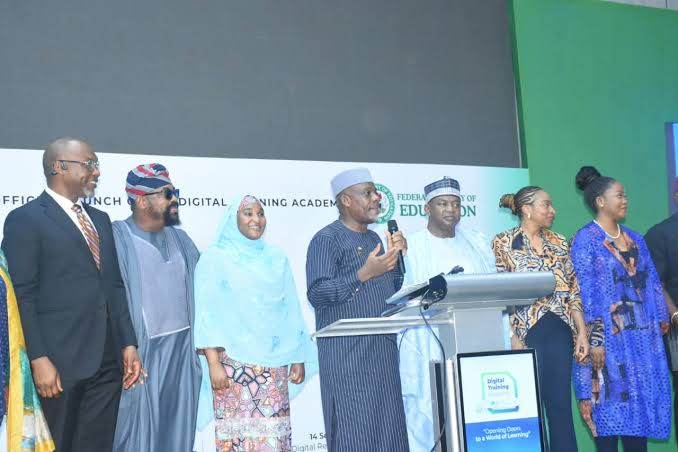
The Minister of Education, Dr Tunji Alausa, unveiled the initiative on Monday in Abuja, describing it as a major investment in young innovators and a key component of President Bola Tinubu’s Renewed Hope Agenda for Education.
“This is not just another grant scheme,” Alausa said. “The Student Venture Capital Grant is designed to identify high-potential ideas on our campuses and nurture a culture of creativity, enterprise and problem-solving among students.”
Under the scheme, selected beneficiaries will receive up to ₦50 million in equity-free seed funding, alongside incubation support, expert mentorship and access to networks and essential tools for building scalable startups.
The programme is jointly implemented by the Federal Ministry of Education and the Tertiary Education Trust Fund (TETFund), in partnership with the Bank of Industry, Afara Initiative, Afrilabs, Entrepreneurship and Skills Development Centre, and Google.
According to Alausa, the grant is open to full-time students in federal, state and private tertiary institutions from Year Three and above, while younger students may participate as members of project teams.
“We know that many successful founders did not succeed on their first attempt, but their journey usually began with a spark,” he said. “This programme exists to light that spark, build confidence and demonstrate the depth of Nigerian ingenuity to the world.”
He added that eligible ventures must be registered with the Corporate Affairs Commission and focused on Science, Technology, Engineering, Mathematics and Medical Sciences.
Every application, the minister explained, will undergo a rigorous evaluation process, with shortlisted teams pitching their ideas before a 12-member panel drawn from academia, industry, venture capital and government.
“Participants will receive detailed feedback and may be paired with complementary teams to enhance collaboration and shared innovation,” Alausa said.
He stressed that while not every idea would become a startup, some could evolve into patents and licensable technologies with far-reaching impact.
“Not every concept will turn into a business, but some will translate into high-value intellectual property that can drive national development,” he noted.
Providing an overview of the initiative, the National Programme Coordinator of the S-VCG Special Programme Unit, Mr Adebayo Onigbanjo, said the scheme was created to bridge the funding gap that often discourages investors from supporting early-stage university innovations.
“So far, the application portal has received nearly 18,000 expressions of interest from 402 tertiary institutions across the country,” Onigbanjo disclosed.
Former Minister of Power, Prof. Barth Nnaji, also commended the initiative, saying it aligns with global best practices in strengthening scientific research and innovation.
“This is how students and their mentors can produce inventions that solve local problems while meeting global needs,” Nnaji said.
The application portal opened on November 17 and will close on January 23, 2026, after which the evaluation process will begin.