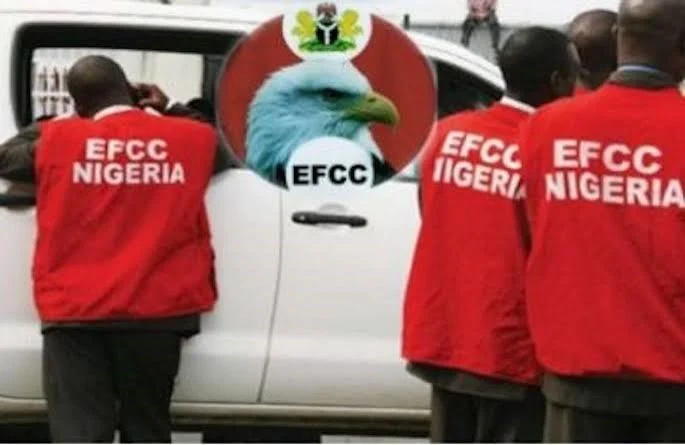
The Economic and Financial Crimes Commission has formally petitioned for the disqualification of Justice Mohammed Umar of the Abuja Division of the Federal High Court from presiding over a case concerning alleged terrorism financing.
In the petition submitted to the Chief Judge of the Federal High Court, Justice John Tsoho, the anti-graft agency expressed that it no longer had confidence in Justice Umar’s ability to handle the matter impartially.
Consequently, the EFCC requested that the case, marked FHC/ABJ/CR/705/2025, involving the Bauchi State Commissioner for Finance, Yakubu Adamu, and three others accused of financing terrorism, be reassigned.
Adamu, a former manager at a Polaris Bank Plc branch in Bauchi State, was arraigned on December 31, 2025, alongside three alleged accomplices identified as civil servants, Balarabe Abdullahi Ilelah, Aminu Mohammed Bose, and Kabiru Yahaya Mohammed—on a ten-count charge.
The EFCC alleges that the defendants engaged in conspiracy, conversion of public funds, and terrorism financing, contrary to Section 2(1) and Section 19(1)(d), punishable under Section 19(2)(b) of the Money Laundering (Prevention and Prohibition) Act, 2022.
According to the agency, the defendants carried out transactions amounting to approximately $9.7 million without using any formal financial institution.
The EFCC told the court that between January and May 2024, Adamu, in collusion with the Bauchi State Accountant-General, Sirajo Jaja, Samaila Irmiya Liman, and the other three defendants, signatories to Bauchi State Government accounts, handed over $2.3 million in cash to Bello Bodejo and associates.
Bodejo, president of Miyetti Allah Kautal Hore, had previously been arrested and charged with three counts of terrorism. He was taken into custody at the Miyetti Allah office in Karu Local Government Area of Nasarawa State shortly after unveiling a vigilante group.
The federal government had accused him of establishing an ethnic militia and engaging in activities prejudicial to national security and public safety.
The EFCC further alleged that Bodejo provided material support, assistance, and transportation for acts connected to terrorism, in violation of Sections 29, 2(3)(g)(xii), 12(a), and Section 2(3)(g)(xii) and 13(2)(b) of the Terrorism (Prevention and Prohibition) Act, 2022.
The charges against him were later withdrawn in May 2024 before he could be arraigned.
In its petition, the EFCC criticized Justice Umar for granting bail to Adamu and his co-defendants despite the seriousness of the allegations and a counter-affidavit arguing for their continued detention.
The commission highlighted that bail had previously been denied by the court before the case was reassigned to Justice Umar.
When the case was called for hearing on Thursday, Justice Umar announced he would temporarily step aside pending the Chief Judge’s decision on the EFCC petition.
Efforts by the defendants’ counsel, Chief Chris Uche, SAN, to continue the proceedings were rebuffed by the judge, who stated his decision was “in the best interest of justice,” and adjourned the case sine die.
It is recalled that Justice Emeka Nwite, who initially handled the case, had denied bail on January 5, ordering the defendants remanded at Kuje Prison.
After reassignment, Justice Umar granted bail on January 21, setting conditions of N100 million each with two sureties of equal sum.
He dismissed EFCC’s claim that the defendants were flight risks, directing them to surrender international passports, seek permission before traveling abroad, and report weekly to the Bauchi DSS office.
The EFCC also alleged that the defendants, with approval from Bauchi State Governor Senator Bala Mohammed, illegally provided funds to Bodejo and associates, knowing the money could be used, in whole or in part, to finance terrorism.
The agency noted that some participants, including the Accountant-General Jaja, remain at large.
The defendants pleaded not guilty and sought bail while awaiting the resolution of the allegations against them.