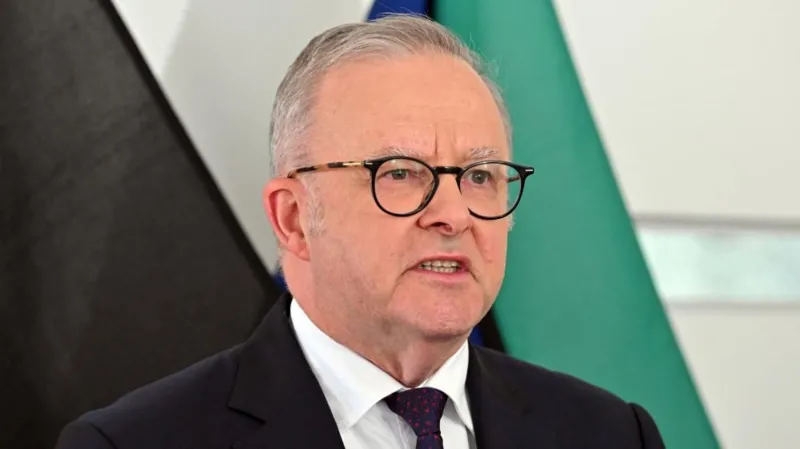
Australian Prime Minister, Anthony Albanese, announced on Monday that the country will formally recognize a Palestinian state in September, aligning with a growing number of Western nations voicing opposition to Israel’s ongoing military actions in Gaza.
Speaking at a press conference, Albanese confirmed that the formal recognition will take place at next month’s United Nations General Assembly.
He said, “Australia will recognize the right of the Palestinian people to a state of their own predicated on the commitments Australia has received from the Palestinian Authority.”
The move coincides with growing momentum across the West. New Zealand’s Foreign Minister Winston Peters revealed that his government is also weighing the step and will reach a decision at a September cabinet meeting.
“New Zealand has been clear for some time that our recognition of a Palestinian state is a matter of when, not if,” Peters said in a statement, echoing similar language from Australian officials in recent weeks.
New Zealand Prime Minister Christopher Luxon described the situation in Gaza as an “absolute human catastrophe,” stressing that, “it was entirely appropriate that we take the time to actually make sure we weigh up our decision and work that through in a sensible way.”
Australia’s decision places it alongside the United Kingdom, France, and Canada, all of which have announced plans to recognize Palestinian statehood in September.
Should Wellington follow suit, four of the five members of the Five Eyes intelligence alliance, Australia, New Zealand, the UK, and Canada, would recognize Palestine, leaving the United States increasingly isolated on the issue.
Australian Foreign Minister Penny Wong disclosed that she informed US Secretary of State Marco Rubio about Canberra’s plans during a Sunday phone call.
The US readout of the discussion omitted any mention of Palestinian recognition. In a recent interview with Catholic broadcaster EWTN, Rubio downplayed the significance of such declarations, describing them as “largely symbolic” and claiming they “emboldened Hamas and made it harder to achieve peace.”
Albanese noted that assurances had been obtained from Palestinian Authority President Mahmoud Abbas that Hamas would be excluded from any future Palestinian government.
Other conditions outlined by Australia include demilitarization, general elections, the abolition of “a system of payments to the families of prisoners and martyrs,” and governance and education reforms, alongside “international oversight to guard against the incitement of violence and hatred.”
He described a two-state framework as “humanity’s best hope to break the cycle of violence in the Middle East and to bring an end to the conflict suffering and starvation in Gaza.” Albanese added, “This is about much more than drawing a line on a map. This is about delivering a lifeline to the people of Gaza.”
Canada and France have pledged recognition in September, while the UK has tied its recognition to conditions, including an Israeli ceasefire in Gaza.
On Sunday, Israeli Prime Minister Benjamin Netanyahu criticized the steps taken by these countries, calling them “shameful.” He said, “To have European countries and Australia march into that rabbit hole, just like that, fall right into it, and buy this canard is disappointing. But it’s not going to change our position. We will not commit national suicide to get a good op ed for two minutes.”
Foreign Minister Wong argued that continuing the same stalled approaches would not bring peace.
“We cannot keep doing the same thing, and hoping for a different outcome. We can’t keep waiting for the end of a peace process that has ground to a halt,” she said, framing the decision as a chance to build momentum towards a two-state solution, which she called “the only prospect for peace.”
The announcement comes as Israel expands its military campaign in Gaza, with plans to seize Gaza City and evacuate up to a million people.
The UN and several Security Council members condemned the move, warning it could trigger “another calamity” and lead to “further violations of international law.”
Head of the UN Office for the Coordination of Humanitarian Affairs in Geneva, Ramesh Rajasingham, said the situation had escalated beyond a looming food crisis. “This is starvation, pure and simple,” he told the Security Council. He reported that since October 2023, 98 children had died from severe acute malnutrition—37 of them since July 1 alone.
The Integrated Food Security Phase Classification, a UN-backed food monitoring body, recently warned that famine conditions were emerging in Gaza. Hunger-related deaths, especially among children, are rising sharply.
Public anger over the crisis is fueling massive protests worldwide. In London, more than 460 demonstrators were arrested during a weekend rally, while in Sydney, over 90,000 people, organizers claim closer to 300,000, marched across the Harbour Bridge. More protests are expected in the coming weeks.