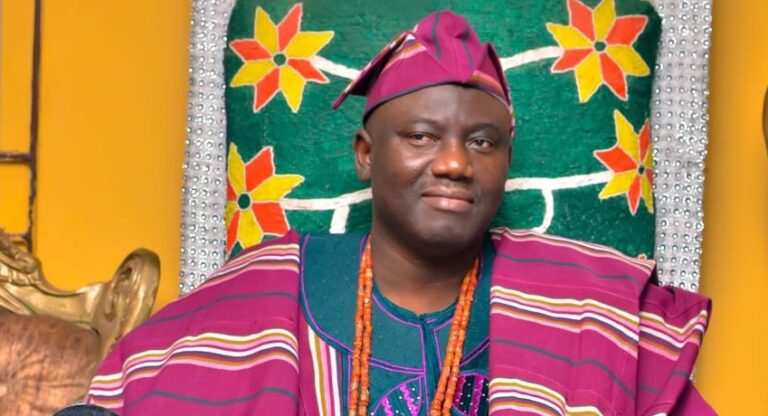
The Alaafin of Oyo, Oba Abimbola Owoade, has declared himself the supreme traditional ruler in Yorubaland, renewing attention on the long-standing debate over the hierarchy and historical significance of Yoruba traditional institutions.
The monarch made the declaration during an interview on State Affairs, hosted by popular broadcaster Edmund Obilo, on November 4, amid the lingering disagreement over royal hierarchy between the Alaafin and the Ooni of Ife, Oba Adeyeye Enitan Ogunwusi.
Oba Owoade said, “I am the supreme king in Yorubaland and the number one king in Yorubaland.”
His declaration comes against the backdrop of a series of disagreements involving prominent Yoruba monarchs, particularly the Alaafin and the Ooni of Ife, Oba Adeyeye Ogunwusi, whose relationship attracted public attention following a disagreement over traditional authority and the conferment of chieftaincy titles.
The Alaafin’s position is closely associated with the historical prominence of the old Oyo Empire, which, at its height, was one of the most powerful political and military empires in West Africa.
The Alaafin occupied the throne at the centre of the empire’s political structure, exercising considerable influence over several Yoruba territories and neighbouring communities.
The Ooni, on the other hand, occupies the revered throne of Ile-Ife, traditionally regarded as the ancestral and spiritual cradle of the Yoruba people.
The two traditional institutions have distinct historical significance, although questions surrounding their respective positions in the Yoruba traditional hierarchy have occasionally generated controversy.
The latest major disagreement between the two monarchs became public in August 2025 when the Ooni conferred the title of Okanlomo of Yorubaland on Ibadan-based businessman, Chief Dotun Sanusi, during the unveiling of a social networking platform at Ilaji Hotel and Sports Resort in Ibadan.
The Alaafin objected to the conferment, arguing that no traditional ruler other than him had the authority to award a title covering the entire Yorubaland.
Through his media aide, Bode Durojaiye, he issued a 48-hour ultimatum to the Ooni to withdraw the title or face the consequences.
The Ooni’s spokesman, Moses Olafare, dismissed the ultimatum, saying the monarch would not be drawn into the controversy.
The disagreement further escalated when the Alaafin cited historical accounts and a British colonial-era treaty to support his claim to traditional supremacy, arguing that the Alaafin had historically been recognised as the superior head of the Yoruba nation.
However, the two monarchs appeared to put their differences behind them in October 2025 when they met in Lagos through the intervention of businessman and philanthropist, Sir Kessington Adebutu, popularly known as Baba Ijebu.
At the meeting, held during Adebutu’s 90th birthday celebration, the monarchs reaffirmed their commitment to peace, mutual respect and the development of Yorubaland.
They also announced the establishment of the Joint Council of Yoruba Unity, aimed at promoting cultural preservation, peacebuilding and socioeconomic development across Yoruba communities.
Despite the reconciliation, controversies surrounding traditional authority in the South-West have continued to attract public attention.
In March 2026, the United States chapter of Afenifere called for restraint and dialogue among Yoruba traditional rulers, recalling the reconciliation between the Alaafin and Ooni and expressing concern over subsequent developments involving traditional institutions.
The group also referenced an alleged handshake incident involving the Alaafin and the Olubadan of Ibadanland, Oba Rashidi Ladoja, at an interfaith gathering in Ibadan in January 2026, as well as a legal dispute between the Alaafin and the Oyo State Government over the elevation of some high chiefs to beaded-crown status.
The Alaafin’s latest declaration is therefore likely to reignite conversations about the historical positions of the two ancient thrones and the question of traditional supremacy in Yorubaland.