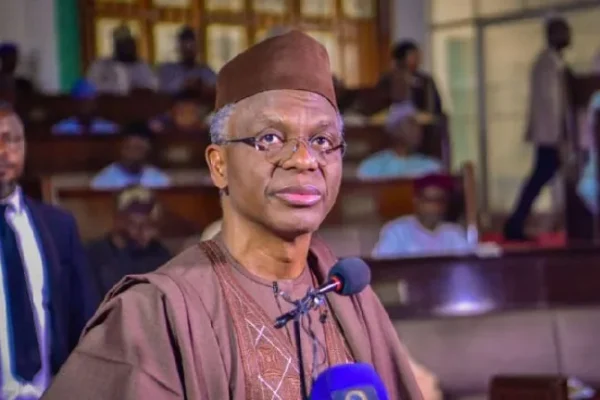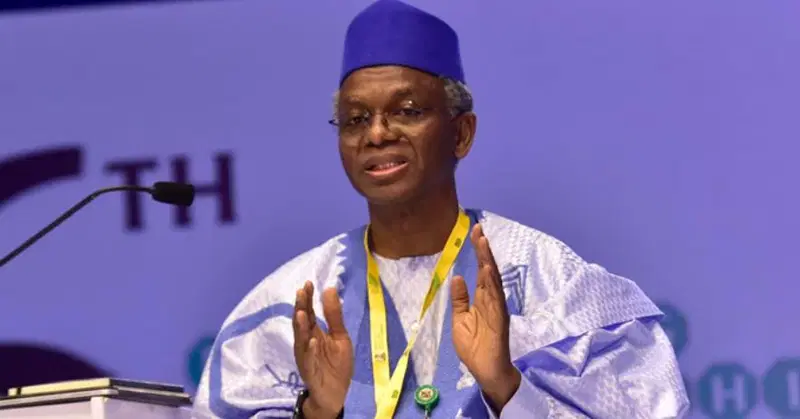
Former Kaduna State Governor Nasir El-Rufai on Wednesday opened his defence in the five-count charge filed against him by the Federal Government over the alleged interception of the telephone communications of National Security Adviser, Nuhu Ribadu.
El-Rufai, who testified before the Federal High Court in Abuja, denied the allegations, insisting that he did not commit any offence capable of threatening national security.
The former governor took the witness box after receiving permission from the trial judge, Justice Joyce Abdulmalik, and was led in evidence by his counsel, Paul Erokoro, a Senior Advocate of Nigeria.
During the proceedings, the court played a video recording of the television interview that led to the charges against him.
The prosecution counsel, Oluwole Aladedoye, did not oppose the admission of the video evidence.
The case stems from comments El-Rufai made during an appearance on Arise Television’s Prime Time programme on February 13, 2026, where he allegedly admitted knowing an individual who unlawfully intercepted Ribadu’s telephone conversations.
The former governor had made the remarks while reacting to an alleged attempt by operatives of the Department of State Services to “abduct” him at the Nnamdi Azikiwe International Airport, Abuja, on February 12, 2026, following his return from Cairo, Egypt.
He had alleged that the security agency was acting on the instructions of the Independent Corrupt Practices and Other Related Offences Commission, which he claimed received a directive from the NSA to detain him.
El-Rufai further claimed that he obtained the information through an individual who had listened to Ribadu’s telephone conversations.
Apart from the allegation of unlawful interception, the Federal Government accused him of failing to report the incident to the appropriate security authorities.
The charges include alleged offences bordering on national security and public safety under Section 12(1) of the Cybercrimes (Prohibition, Prevention, etc.) (Amendment) Act, 2024.
Following the prosecution’s presentation of two witnesses and the closure of its case, El-Rufai filed a no-case submission, asking the court to discharge and acquit him on the grounds that the evidence presented was insufficient to warrant him entering a defence.
However, Justice Abdulmalik dismissed the application, ruling that the prosecution had presented sufficient evidence to require an explanation from the defendant.
She subsequently directed him to open his defence.
The court had earlier, on October 26, ordered the former governor to defend himself after rejecting his application to terminate the trial.
El-Rufai had also challenged the competence of the charge, marked FHC/ABJ/CR/99/2026, arguing that the DSS wrongly interpreted his television comments as an admission of criminal conduct.
He maintained that his remarks did not amount to a confessional statement, arguing that they were made during a voluntary public discussion without caution or warning from law enforcement officers.
“A casual remark on a television programme cannot be elevated to a judicial confession,” he argued in his application.
He had also contended that a statement could only qualify as a confession if it was made voluntarily under circumstances that satisfied the Judges’ Rules.
The court, however, declined to quash the charge and directed that the case proceed on an accelerated basis.
El-Rufai, who governed Kaduna State from 2015 to 2023, has remained in detention since February and is facing separate legal proceedings in Abuja and Kaduna.
In July, Justice Abdulmalik also rejected his application seeking a relaxation of his bail conditions, which his lawyer described as difficult to fulfil.
The conditions included producing Grade Level 17 civil servants with properties in Maitama or Asokoro, Abuja, as sureties, alongside verification and attestation letters from the Kaduna State Traditional Council.
The prosecution opposed the application, arguing that qualified public officers capable of meeting the requirements were available.