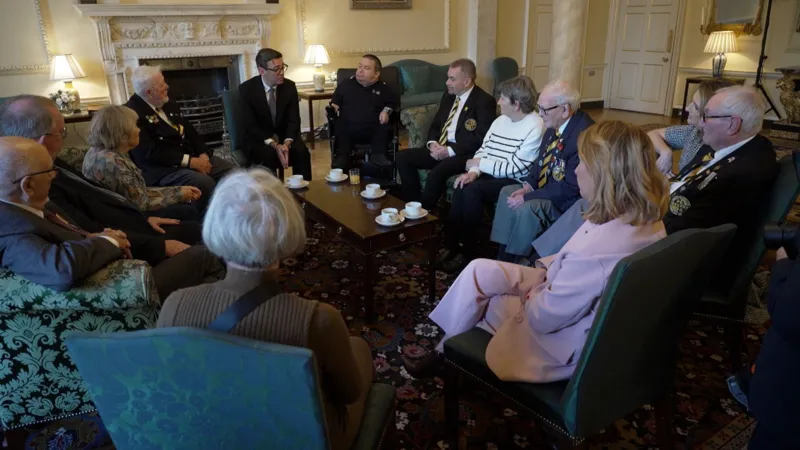
United Kingdom Prime Minister, Andy Burnham, has announced plans for an independent investigation into the long-term health effects of Britain’s Cold War-era nuclear weapons tests, assuring surviving veterans and their families that they will receive the full truth about their experiences.
The investigation, modelled on the Hillsborough Independent Panel, will examine the potential consequences of nuclear testing exercises conducted by Britain during the 1950s and 1960s, particularly the alleged exposure of military personnel to dangerous radiation.
The panel will be chaired by James Jones, the former Bishop of Liverpool, who also led the Hillsborough investigation.
The announcement followed decades of campaigning by nuclear test veterans and their families, who have repeatedly demanded an investigation into illnesses they believe were caused by radiation exposure.
Many of the tests were conducted in Australia and the South Pacific, where British military personnel were deployed to participate in the exercises.
Some veterans have alleged that they were ordered to fly through radioactive clouds without protective equipment, watch nuclear explosions without adequate shielding and live in areas contaminated by radioactive materials.
They also believe exposure contributed to cancers, other illnesses, fertility complications and hereditary health problems among their children and descendants.
Speaking to campaigners at Downing Street, Burnham praised their determination and promised that the investigation would establish what happened during the testing programme.
“All I can say is you know the courage you’ve shown, the dignity you’ve shown through the whole thing, given everything that happened, is honestly something that we just are in awe of.
“Your patience, your strength, your determination – and we will make sure that this process moves as quickly as possible to get you what you long deserved, which is the full truth… Obviously, I do not know what the full truth will be, but we will get it.”
The investigation follows years of complaints against the Ministry of Defence, which has consistently denied allegations that it concealed evidence of radiation-related illnesses among military personnel involved in the nuclear tests.
The ministry has previously cited four studies that found no increased health risks among participants, including research conducted by Brunel University in 2022.
However, veterans and campaigners have challenged the findings, accusing the department of withholding important medical records, including blood and urine test results, which they believe could establish a connection between radiation exposure and subsequent illnesses.
The Ministry of Defence released some official documents in July 2026 but acknowledged that certain records might have been inadvertently destroyed three years earlier.
It also explained that retrieving the medical records had proved difficult because the military did not maintain a central database, partly due to the secrecy surrounding nuclear testing during the Cold War.
One of the veterans seeking justice is John Morris, who worked as a laundry operator at a nuclear test site and later developed cancer.
He also lost his four-month-old son, which he believes was connected to his exposure to radiation.
Recounting his experience, Morris said, “Seventy-two years ago I was an 18-year-old, sent to Christmas Island, totally unaware of what I was being led into.
“I am here today and I am looking for, and sincerely hope we will get, justice.”
Another veteran, Brian Unthank, said he witnessed three hydrogen bomb explosions in the Pacific without protective equipment and subsequently developed multiple skin cancers.
He said, “I’ve always wanted to get a prime minister… to stand up in Parliament and make a total, abject apology for the total mess-up of the way they treated us veterans and the families through this 74 years.
“Next year is our 75th year of misery. Let’s get it done today.”
The consequences of the testing programme have also been a source of concern for the veterans’ descendants.
Barbara Quick, whose father served in the Royal Air Force Police on Christmas Island, said she had been unable to have children, while two of her sister’s children had died.
She attributed the health complications to her father’s alleged radiation exposure.
“If you were higher personnel you got the gas mask, you got the suit – but my father was told to turn his collar up, turn his back and cover his eyes,” she said.
Similarly, Steve Purse, whose father participated in the nuclear tests, said he was born with complex disabilities that had never been fully diagnosed.
He described the announcement of the investigation as significant but insisted that the panel must be allowed to disclose all relevant information.
“No-one has listened to us like this before, it’s a moment of history,” he said.
Burnham had previously supported calls for an investigation before becoming prime minister earlier this year, describing the alleged treatment of nuclear test veterans as a “criminal cover-up on an industrial scale”.
The panel is expected to submit its report by October 2027, coinciding with the 75th anniversary of Britain’s first nuclear weapons test.
Defence Secretary Wes Streeting acknowledged that the investigation had taken too long to materialise, expressing concern that many veterans had died without receiving answers.
“It’s taken too long to get here and I think today of the people who haven’t lived to see this moment – and I fear for the people who might not see the outcome,” he said.
Streeting also acknowledged the lack of trust between veterans and the Ministry of Defence, assuring campaigners that the department would not participate in establishing the panel or determining its terms of reference.
He said the investigation would “help us to make sure that the cover-up is exposed”.
Asked whether the government would consider compensation if the panel recommended it, Streeting declined to prejudge the findings but said he was “absolutely sure the findings will be uncomfortable” and that the government “will have to take that on the chin”.