

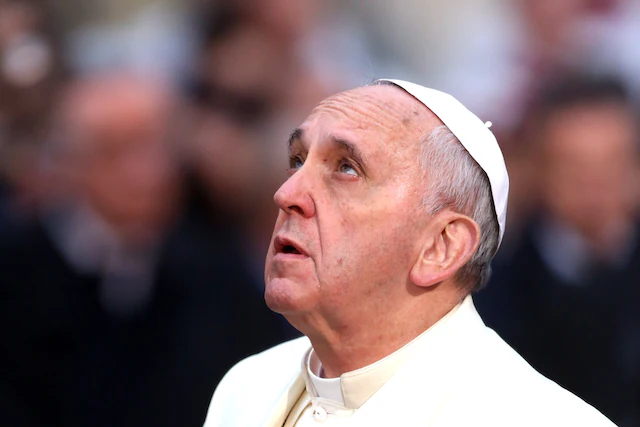
The late Pope Francis experienced visions of the Devil and the entrance to Hell during a period of intense spiritual struggle, according to his private diaries published on Tuesday.
The diaries, which offer rare insights into the religious and personal life of the former Catholic leader, also reveal that he battled a two-year spiritual crisis beginning in 2021, during which he struggled with the responsibilities of leading the Church and resisted the temptation to manipulate people through his position of authority.
Francis, who died in April 2025 at the age of 88 after leading the Catholic Church for 12 years, documented his spiritual experiences in a small planning notebook dating back to 1992.
The entries, which continued until August 2024, were compiled into a 160-page book titled The Private Diary of Pope Francis, released on Tuesday.
In a December 2022 entry, Francis described the difficulties he experienced during the crisis, writing, “It was all mixed with governance issues, pressure regarding decisions to make, and aridity and desolation.”
According to Cardinal Victor Fernandez, a close associate of the late pope who compiled the diaries and provided accompanying commentary, Francis considered the period his most difficult spiritual trial.
Fernandez wrote that Francis “ultimately recognised that it was the worst trial that had tormented him … and that he felt that he was in a continual battle not to fall into this demonic seduction.”
In a January 2021 entry, Francis recalled three occasions during his life when he believed he had encountered the Devil, including one incident during a meeting with Vatican officials while he was pope.
Describing the experience, he wrote, “I can’t forget the powerful raspiness of his voice. The Lord granted me an opportunity to leave that meeting, and he thus freed me.”
The former pontiff also recounted an encounter with what he believed was the entrance to Hell in June 2018.
“Last night I saw the entrance to Hell,” he wrote. “I peeked in to look a little, and it terrified me.”
He added, “I grabbed the Rosary as a weapon. I thank the Lord for this help.”
The diaries also shed light on Francis’ approach to leadership and his reluctance to use his authority to control others.
Fernandez recalled a 2023 meeting during which another bishop questioned why Francis had not publicly reprimanded a Vatican official who had criticised him.
The late pope reportedly explained that he felt God did not want him to become someone who manipulated people for personal convenience.
The book also contains reflections on some controversial moments during his papacy, including his 2018 visit to Chile, where he faced criticism for initially dismissing allegations of sexual abuse and a cover-up involving a bishop.
Francis later apologised over his handling of the controversy and invited the country’s bishops to Rome, where they collectively offered to resign.
Reflecting on the episode in a 2021 diary entry, he wrote, “Devastated because of the situation in Chile. It was hard for me to admit what happened in Chile; I didn’t think it was so serious.”
Despite his disagreements with several senior Catholic figures, Francis also expressed positive opinions about some of his critics.
The diaries contain favourable remarks about Guinean Cardinal Robert Sarah and German Cardinal Gerhard Muller, both of whom had openly criticised aspects of his leadership.
Francis described Sarah as having “a refined spiritual sensitivity”, while he reportedly said of Muller that he “seems aggressive, but he’s a good man”.
He also praised Cardinal Robert Prevost, who succeeded him following his death and became Pope Leo XIV in May 2025.
According to Fernandez, Francis described Prevost as “a great pastor, a generous missionary, and an irreproachable man”.
The publication is particularly significant because most recent popes have traditionally directed that their personal papers be destroyed after their deaths.
The last pope whose diaries were published posthumously was Pope John XXIII, who died in 1963.
The release of Francis’ writings therefore provides an unusual glimpse into the private spiritual experiences and personal struggles of a pontiff whose leadership attracted both widespread admiration and criticism.


