

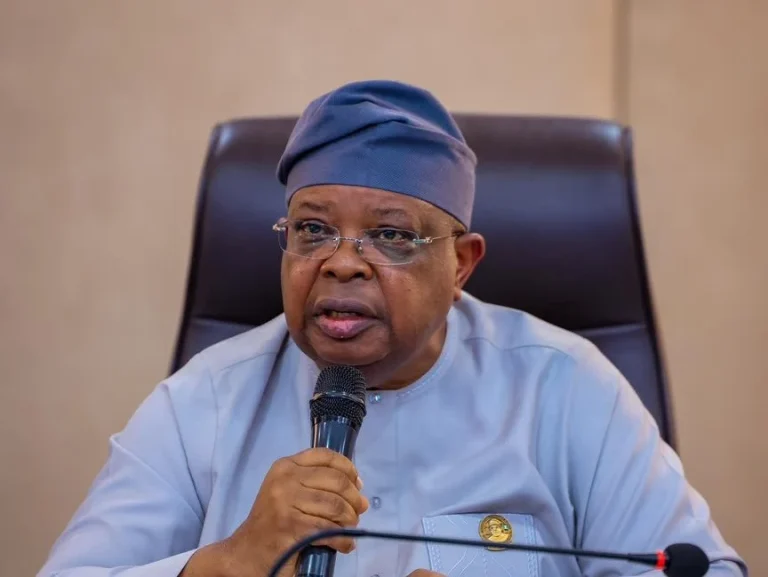
Some Nigerians and civil society organisations have called for the resignation of the Minister of Power, Joseph Tegbe, over persistent electricity outages nationwide, accusing him of incompetence and failing to address the worsening power crisis.
The calls followed the minister’s Saturday post on X, formerly Twitter, in which he explained the causes of the recent electricity disruptions and outlined measures being taken to restore supply.
Tegbe attributed the outages in some parts of the country to scheduled maintenance at the Egbin Power Station and inadequate gas supply to certain thermal power plants.
He assured consumers that electricity would be restored within 48 to 72 hours.
The minister said the government was collaborating with power sector operators to address gas supply challenges and fix damaged infrastructure.
“My team and I are working to return the affected generating units to service in phases, with the first units coming back online within the next 48 to 72 hours,” he said.
In a separate update, Tegbe disclosed that the ministry had secured the release of 98 out of 300 containers of transmission equipment that had been held at the ports for almost two decades.
According to him, the equipment would facilitate the completion of abandoned projects, reduce pressure on overloaded substations and improve the national grid.
The development comes amid mounting complaints from electricity consumers over declining hours of supply.
The Nigerian Independent System Operator had identified insufficient gas supply and reduced water inflows into hydroelectric reservoirs as major factors limiting electricity generation.
Data on electricity distribution also showed that the 11 distribution companies received a combined allocation of 2,926 megawatts as of 4:41 pm on Thursday.
However, the minister’s explanation sparked criticism on social media, with several Nigerians accusing the government of repeatedly offering excuses for the country’s persistent electricity crisis.
While some users faulted Tegbe for failing to notify consumers ahead of the maintenance work, others demanded his resignation, insisting that the worsening power situation was unacceptable and required urgent reforms.
The National President of the Committee for the Defence of Human Rights, Yinka Folarin, described the minister’s explanation as unsatisfactory, accusing him of incompetence and saying he could no longer be trusted to manage the sector.
Folarin also urged Tegbe to resign, alleging that he had misled Nigerians over the persistent electricity challenges.
He said, “The minister should be honourable to say, ‘Come, I am not competent,’ and give room for a more competent person. Those excuses he has brought forward are not sustainable.”
The CDHR president, who criticised the minister for failing to provide lasting solutions to erratic electricity supply, said he doubted that the situation would improve under Tegbe’s leadership.
He added, “It will not be out of place to say that he should take a bow out of that office and give room for a more solution-driven person to man the affairs of that ministry.”
Folarin also condemned the financial burden imposed on consumers, lamenting that Nigerians continued to pay exorbitant electricity bills despite receiving poor supply or, in some communities, going without power for weeks.
He described the billing of communities without electricity as unfair and barbaric, calling on the Federal Government to intervene.
The National Coordinator of the Human Rights Writers Association of Nigeria, Emmanuel Onwubiko, also criticised the minister in an interview with The PUNCH, describing his handling of the power crisis as disappointing.
Onwubiko accused Tegbe of making “unscientific claims about electricity supply,” recalling his previous assertion that Nigerians were requesting load-shedding because the country had excess electricity.
He dismissed the minister’s promise to restore adequate supply within 72 hours as another excuse.
Onwubiko also questioned President Bola Tinubu’s commitment to improving electricity supply, citing his campaign pledge to deliver 24-hour power or risk losing re-election.
The rights advocate called for an investigation into the power ministry, accusing the Economic and Financial Crimes Commission and the Independent Corrupt Practices and Other Related Offences Commission of failing to adequately address alleged financial misconduct in the sector.
On the minister’s possible resignation, Onwubiko argued that removing him would not automatically resolve the crisis, stressing the need for a competent successor.
The Executive Director of the Civil Society Legislative Advocacy Centre, Auwal Rafsanjani, said Nigerians had legitimate grounds to demand accountability over the persistent electricity crisis.
He insisted that Tegbe should be held responsible for the failures recorded under his supervision.
Rafsanjani said the minister’s performance should be subjected to an independent assessment based on measurable targets, adding that failure to meet the benchmarks should attract consequences, including removal from office.
He noted that the electricity crisis was driven by systemic challenges such as poor planning, corruption, inadequate infrastructure, gas shortages and weak regulation.
However, he warned that the structural nature of the problems should not absolve public officials of responsibility for their individual roles.
Rafsanjani called on the Federal Government to conduct an urgent audit of expenditure in the power sector, address gas supply challenges, modernise electricity infrastructure and enforce strict performance standards for sector leaders and operators.
Nigerians react
Several Nigerians also expressed their displeasure with the minister’s explanation on social media.
An X user, Oluwafemi Ojo, criticised the timing of the update, saying the minister had taken too long to address the worsening situation.
He wrote, “It is unfortunate that the minister is just telling us this two months after the power situation had worsened. Please resign sir. Thank you.”
Another user, Legendarytakes, called for the minister’s resignation, saying, “In a sane country, you should be resigning!”
A user identified as Official_dags also faulted Tegbe for allegedly failing to address the situation promptly.
“Resign! This has been on for three months and you’re only now addressing it,” the user wrote.
Another commenter, Zamba, accused the minister of failing to anticipate challenges in the sector, including infrastructure breakdowns and gas shortages.
“You are a very incompetent minister of power. You have failed in your duty. Are you not supposed to be proactive when discharging your responsibilities? Must you wait for the infrastructure to fail or low shortage of gas supply before swinging into action to do your job? Resign now!” the user wrote.
Michael Krusu also described Tegbe as a “minister of darkness”, arguing that he would have resigned if he were serving in a country where public officials were held accountable.
However, some Nigerians advocated structural reforms rather than focusing solely on the minister’s removal.
Wemimo Oluwalade called for the decentralisation of the national electricity grid and the creation of regional grids, arguing that the existing arrangement had failed to provide reliable power.
He said, “Please decentralise this national grid, sir. Let’s have regional power grids as campaigned by APC. There is no excuse for this shambolic power situation.”
Temiloluwa Awonbiogbon blamed successive administrations for failing to prioritise electricity supply, arguing that Nigeria needed a government capable of generating, transmitting and distributing 10,000 megawatts within three to four years as an initial measure.
Meanwhile, the Oyo State Coordinator of the Campaign for Democratic and Workers’ Rights, Abiodun Bamgboye, said the minister’s resignation would not resolve the electricity crisis, insisting that the problems extended beyond the person occupying the office.
Bamgboye described Tegbe’s explanations as lame excuses, questioning the claim of inadequate gas supply during the rainy season, when hydroelectric power was expected to play a greater role in electricity generation.
He said, “How can they be claiming a shortage of gas when we are in the rainy season? According to their usual explanations, it is during the dry season, when water levels reduce, that they depend on gas to generate electricity. During the rainy season, they often claim to rely on hydroelectric power.
“So, the argument about gas shortage should not arise at this stage. They can claim that there is maintenance, but maintenance should have a time frame, and Nigerians ought to have been notified before it commenced. There was no prior notification, and it is only now, when electricity supply has deteriorated, that they are coming up with that explanation.”
He further argued that Nigeria’s electricity generation capacity remained inadequate for a population of more than 200 million, noting that the country was struggling to distribute less than 10,000 megawatts.


