

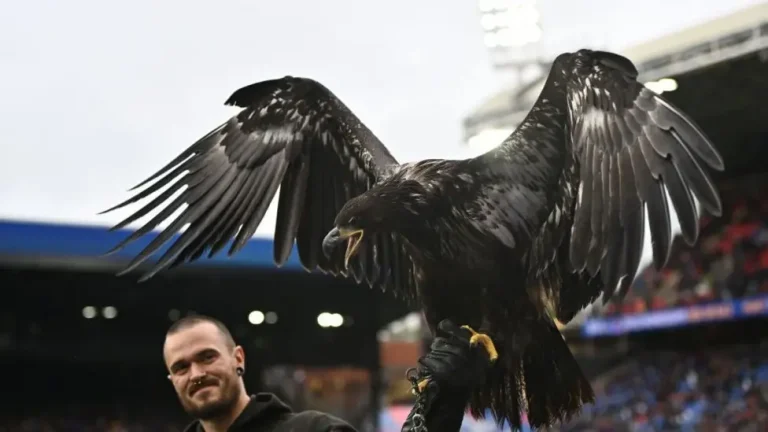
Animal rights organisation People for the Ethical Treatment of Animals has called on English Premier League club Crystal Palace to discontinue the use of its live bald eagle mascot, Phoenix, arguing that football stadiums are unsuitable environments for animals.
In a letter sent to the club’s chief executive, Sharon Lacey, on Wednesday, the organisation demanded the immediate retirement of Phoenix and urged the club to abandon the use of live animals as mascots.
Crystal Palace adopted the nickname Eagles in 1973, having previously been known as the Glaziers.
The club introduced a live eagle to its matchday activities in 2010.
The first bird to serve in the role was Kayla, who remained the club’s mascot for 10 years before her death in 2020.
Phoenix subsequently took over, making her debut during a match against West Ham in August 2024.
PETA said the atmosphere at football grounds, characterised by intense lighting, loud noises and large, energetic crowds, could expose birds to distress and confusion, potentially endangering both the animals and spectators.
The organisation also argued that keeping eagles for entertainment deprives them of the opportunity to exhibit their natural behaviours, leaving them stressed and frustrated.
To support its position, PETA highlighted previous incidents involving live animal mascots, including cases in which birds suffered injuries or died after colliding with walls, windows and footballs.
It also cited an incident involving a falcon that drove its talons into a spectator’s scalp.
In another incident in 2017, a Charlton Athletic supporter was convicted of attempting to punch Kayla during a League Cup fixture.
PETA’s senior corporate projects manager, Dr Carys Bennett, said the club could maintain the excitement associated with its mascot without using a live animal.
“Many professional sports teams use only willing humans as mascots, and the club already has Pete the Eagle to excite the crowd.
“Bald eagles are widely recognised as symbols of freedom. They deserve better than to be used as an entertainment prop to amuse the Eagles’ fans.”


