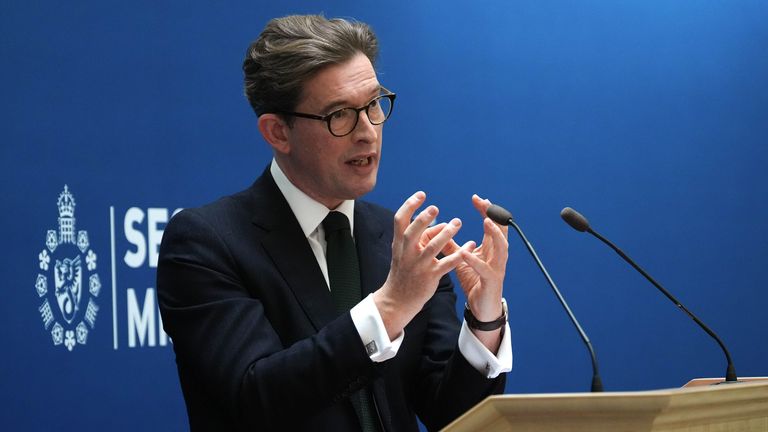
The head of the United Kingdom’s domestic intelligence agency, MI5, Sir Ken McCallum, has warned that the country faces growing security threats from Russia, Iran and emerging artificial intelligence technology, saying foreign adversaries’ threats have quadrupled over the past decade.
McCallum, who described Russia as “aggressor number one”, said MI5 was committing more resources to tackling threats from foreign states than it did during the Cold War.
Speaking during his annual address at the agency’s headquarters in London, he said “our terrorism and state threats operational missions are pretty much of equal scale”, highlighting the increasing pressure on the intelligence service.
He accused Russia of conducting hybrid warfare against the UK and other European countries while avoiding actions that could trigger a collective response from the North Atlantic Treaty Organisation.
According to him, Russia has stopped short of engaging in “conventional conflict” with the military alliance, instead seeking to destabilise European countries while making limited progress in its invasion of Ukraine at a “minimal and horrifically costly” price.
McCallum said MI5’s efforts to identify and expel Russian spies had weakened Moscow’s intelligence network in the UK, forcing the Kremlin to rely increasingly on intermediaries to carry out hostile activities.
He said, “With its traditional covert footprint eviscerated by almost 1,000 expulsions since the invasion, the Kremlin’s global toolkit is weak. So we see them scrambling to pay criminals to do their bidding.”
He added, “These are not the actions of a great power with the strategic upper hand.”
The intelligence chief also warned that Iran was expanding its campaign of hostile activities in Britain, disclosing that 50 arrests had been made over Iran-linked activities in the past year.
He said many of the activities targeted Jewish communities, while others were directed at more heavily protected locations, including military installations.
Although McCallum did not directly address arrests connected to RAF Fairford, Prime Minister Andy Burnham had described an alleged plot there as “almost certainly directed by Iran’s Islamic Revolutionary Guard”.
McCallum warned that individuals involved in such activities would face a strong response from the British authorities.
“What I can say is that those who seek to cause mayhem on British streets – whether hired thugs here or their paymasters overseas – will meet an unflinching response,” he said.
He noted that the National Security Act, introduced in 2023 to address activities carried out on behalf of foreign powers against British interests, was being extensively used to counter threats linked to China, Iran and Russia.
Turning to artificial intelligence, McCallum said the technology was increasing the capabilities of both cyber attackers and those working to defend against them.
“AI is already supercharging the cybersecurity contest between attackers and defenders,” he said.
He warned that the technology could be used to generate propaganda and radicalisation materials tailored to individuals, making it easier for extremist groups to influence potential recruits.
“We’ve caught terrorists seeking to exploit Al to improve their reconnaissance and attack methodologies, with Al-enabled drones adding a new twist,” he added.
McCallum identified the possibility of extremist groups using AI to develop biological weapons as his greatest concern among emerging technological threats.
Although he said the threat had “not yet realised”, he warned that advances in the technology could significantly increase the danger posed by existing or new biological weapons.
“These risks are real. The UK Intelligence Community – MI5, GCHQ, MI6 – is working closely with the UK’s globally respected AI Security Institute to take them on,” he said.
He also highlighted the uncertainty surrounding AI’s future capabilities, saying, “Put at its simplest, human history has given us no experience of facing an actor which is smarter than we are”.
His warning comes after Britain’s terrorism threat level was raised to severe in April for the first time in five years, indicating that a terrorist attack was considered highly likely.
McCallum said Islamist extremist organisations, including Al-Qaeda and the Islamic State group, continued to direct and inspire attacks.
However, he said the growing threat was also being driven “in significant part” by extreme right-wing terrorism.
He identified an increase in cases involving anti-immigration and anti-Muslim grievances that had developed into terrorist intentions as a particularly worrying trend.
“Over the last year the most marked trend has been an increase in cases where extremist versions of anti-immigration and anti-Muslim grievance are tipping into terrorist intent,” he said.
The MI5 chief added that extreme right-wing terrorism was increasingly affecting young people, with the internet playing a significant role in radicalisation.
He disclosed that the agency had recently investigated a 13-year-old in the UK who had been radicalised by extreme right-wing ideology.
“That investigation generated insight that enabled one of our international partners to prevent a lethal attack on their soil,” McCallum said.