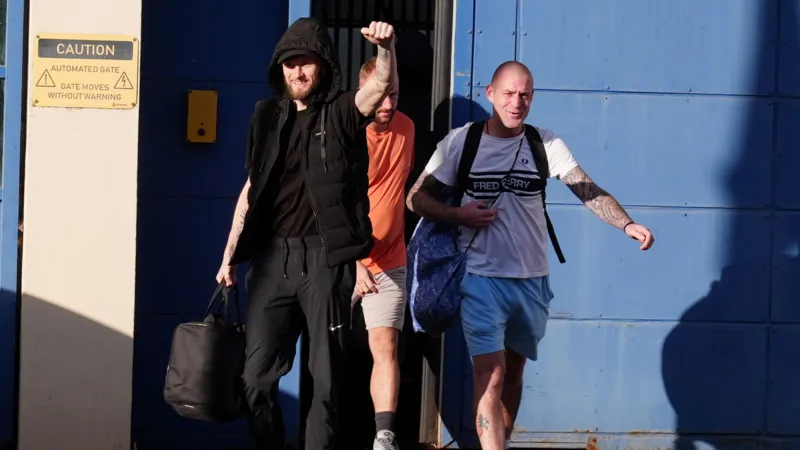
About 650 prisoners are being released early from jails across England and Wales on Tuesday as the United Kingdom government begins the second phase of its scheme to ease overcrowding in prisons.
The latest releases cover offenders serving sentences of up to two and a half years, who are now eligible to leave prison after serving one-third of their terms instead of half.
The development comes as the government prepares to present its criminal court reform plans to Parliament, while probation officers face a potential industrial action over pay and workload.
About 700 prisoners were released under the first phase of the scheme on October 1, with all of them serving sentences of less than 19 months.
The second phase will gradually include offenders serving longer sentences, with the process expected to extend to prisoners serving more than 12 years by June next year.
The government initially planned to release about 6,000 prisoners under the scheme, but the number has been reduced to approximately 5,000 after ministers exempted rapists and the most serious child sex offenders.
Those convicted of manslaughter are also excluded, meaning the killers of police officer Andrew Harper, who died while on duty in 2019, will not qualify for early release. Other ineligible offenders include members of child grooming gangs convicted of indecent assault.
However, victims’ groups have expressed concerns about the scheme, particularly the release of domestic abuse perpetrators.
Alice Russell-Harris of Refuge, a charity that supports survivors of domestic abuse, told the BBC that releasing such offenders “will put survivors at serious risk of harm.”
She said that although some released prisoners would be subject to electronic tagging and restrictions on where they could go, “we know that license conditions are frequently breached by perpetrators.”
Russell-Harris added that victims feared those released from prison “will be able to continue their campaign of abuse once out of prison,” amid concerns that electronic monitoring devices were not always fitted before offenders left custody.
Prisoners released under the scheme are generally expected to wear electronic tags and comply with other monitoring requirements during the remaining two-thirds of their sentences.
The probation service has also raised concerns about its capacity to supervise the growing number of offenders returning to their communities.
Ian Lawrence, general secretary of the probation officers’ union Napo, told the BBC that its members were “absolutely overwhelmed with work.”
He said the released prisoners required “intensive supervision” and that “the sheer weight of numbers causes pressure”.
“None of our people go to work to see people injured, hurt, or for reoffending to happen,” Lawrence said, adding that the probation service needed more resources to manage the releases effectively.
Concerns have also been raised about delays in fitting electronic tags used to monitor offenders’ movements and ensure compliance with curfews and other court or prison conditions.
A report by His Majesty’s Inspectorate of Probation found that almost half of electronic tags used to monitor offenders were not fitted on time, with some prisoners waiting as long as five months.
Official figures showing whether the situation has improved are not expected to be published for several months.
Meanwhile, Napo members are preparing to discuss a proposed ballot for industrial action next week over pay and working conditions.
The Ministry of Justice has offered probation officers a five per cent pay rise, but the union had demanded 12 per cent to compensate for lost earnings following cuts introduced from 2010.
The ministry described its offer as fair, noting that two other unions had accepted it.
It also cited a £700m investment in probation services, which includes recruiting 1,300 additional officers and introducing artificial intelligence tools to reduce workloads.
The early release scheme has already seen some beneficiaries return to custody.
Greater Manchester Police said eight men were arrested days after being released under the programme.
Five were arrested for breaching criminal orders, including a domestic abuse prevention order, while others were detained on suspicion of offences including robbery, drug-related crimes and domestic violence.
Alongside the prison releases, the government is pursuing reforms aimed at reducing delays in the criminal justice system.
The revised proposals abandon a controversial plan to establish a new type of Crown Court in which judges would decide certain cases involving sentences of up to three years without juries.
However, jury trials would still be removed for the most complex and lengthy fraud cases.
The government also plans to keep another 5,500 trials in magistrates’ courts by removing defendants’ right to elect for a jury trial.
Ministers intend to expand the use of so-called blitz or short-trial courts, which group similar cases together to accelerate proceedings and reduce the backlog of cases awaiting trial.
A pilot programme at the Old Bailey reportedly helped cut the London backlog of about 500 cases involving assaults on emergency workers by half over the summer.
Following a review of the criminal courts by former appeal judge Sir Brian Leveson, the government has also approved pilots allowing defendants to appear at court remotely from police cells to reduce delays associated with transporting them to and from custody.
On Monday, the government announced that it had accepted more than 150 of Leveson’s 180 recommendations for modernising the criminal courts.
However, it rejected his recommendation to retain the restriction limiting volunteer magistrates to imposing a maximum of 12 months in prison.
Under the government’s proposal, magistrates would be able to sentence offenders to up to two years’ imprisonment, a move intended to keep more cases out of Crown Courts and help reduce the backlog.