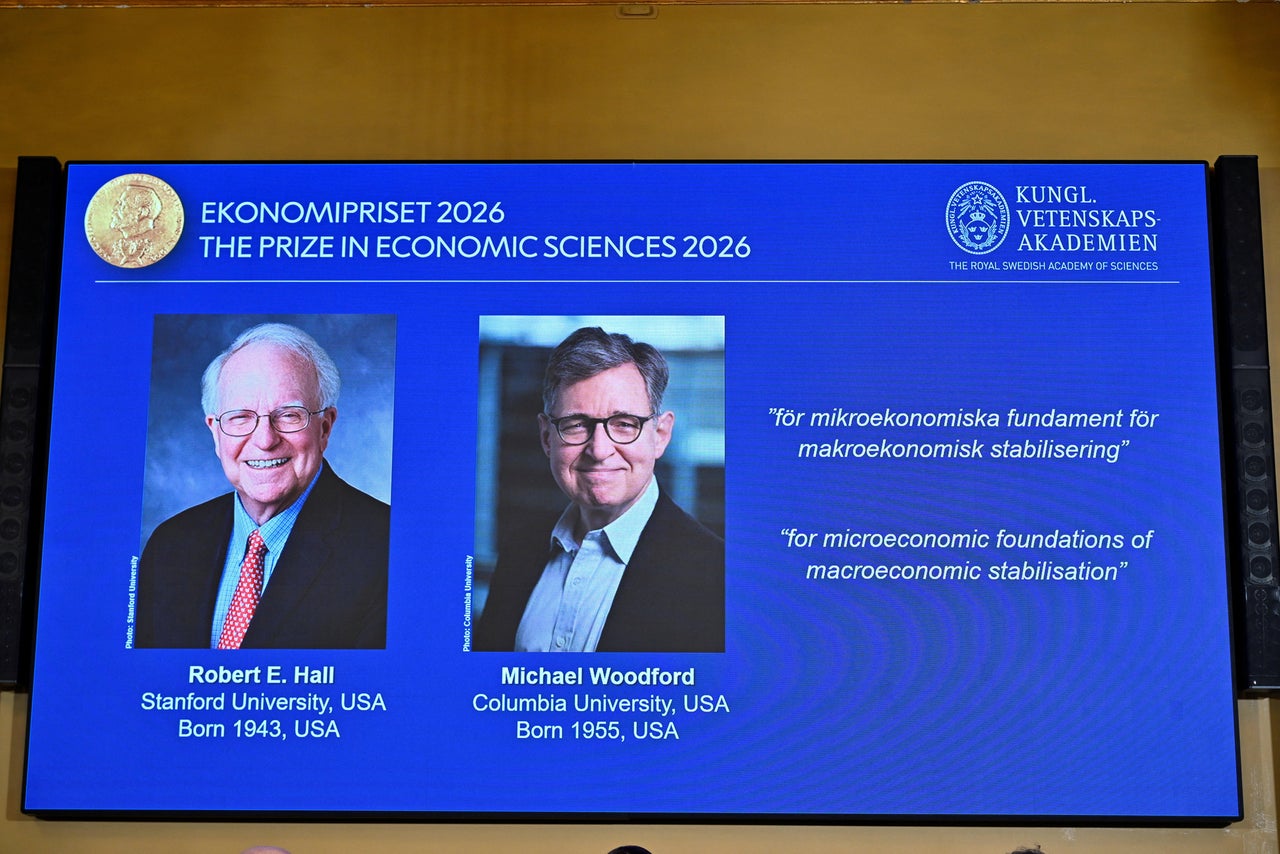
Two American economists, Professors Robert E. Hall and Michael Woodford, have won the 2026 Nobel Prize in Economic Sciences for developing economic models that help governments and central banks manage economic downturns and reduce the effects of external shocks.
The Royal Swedish Academy of Sciences announced the award in Stockholm on Monday, recognising the duo’s contributions to economic models that guide policymakers in stabilising economies during periods of uncertainty.
Announcing the award, the academy said, “The laureates have helped us smooth out the economy’s peaks and troughs,” adding that their models have been “extremely helpful in dealing with the economic downturns that have affected us.”
Hall, born in Palo Alto, California, in 1943, is a professor at Stanford University, while Woodford, born in Chicopee, Massachusetts, in 1955, teaches at Columbia University.
Each recipient will receive six million Swedish kronor, equivalent to approximately $598,000, as part of the award.
The chair of the Committee for the Prize in Economic Sciences, John Hassler, said their research had established a reliable theoretical basis for economic models used by governments and central banks worldwide.
Their work “has provided us with a stable theoretical foundation for the models that are now used by central banks and governments around the world,” Hassler said.
“With them, we are better equipped to deal with shocks in the economy, such as energy crises or sudden changes in how much households consume,” he added.
Unlike traditional approaches that focus on relationships between broad economic indicators such as inflation, production and consumption, Hall and Woodford examined how individual decisions and household behaviour influence the wider economy.
A key element of their research is the recognition that households and businesses make decisions based on their expectations of the future, particularly when determining how much to save or what prices to charge for goods and services.
According to the academy, governments and central banks can shape these expectations by clearly communicating their fiscal and monetary policy plans, helping to steer economic activity in a desired direction.
The economics award, formally called the Sveriges Riksbank Prize in Economic Sciences in Memory of Alfred Nobel, was not among the original prizes established by Alfred Nobel.
It was introduced by Sweden’s central bank in 1968.
The latest award brings the total number of recipients to 101, with only three women among them.
Since the prize was first awarded in 1969, fewer than half of the awards have gone to a single recipient.
The announcement concludes this year’s Nobel Prize awards.
South African judge and human rights advocate Navi Pillay received the Nobel Peace Prize on Friday, while Canadian writer Anne Carson was awarded the Nobel Prize in Literature on Thursday.