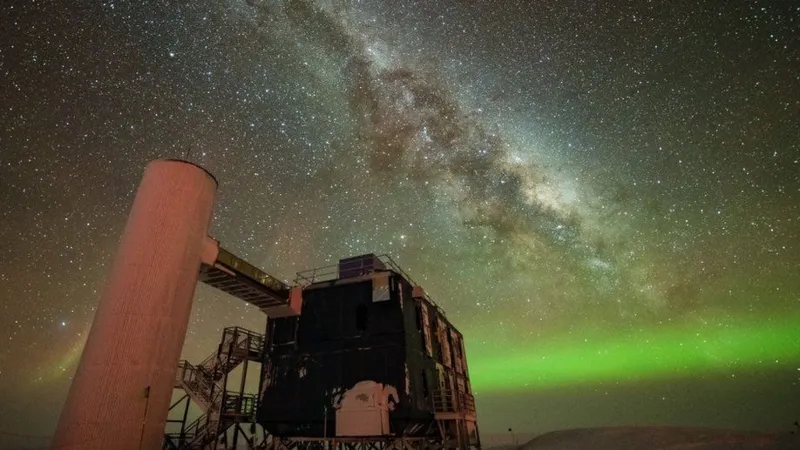
Nelgian-born physicist and United States citizen, Prof Francis Halzen, has won the 2026 Nobel Prize in Physics for his pioneering work on the IceCube Neutrino Observatory, which detects elusive particles from deep space.
Halzen led the development of the observatory at the South Pole, where thousands of light sensors are embedded in a vast block of Antarctic ice to detect high-energy neutrinos produced by violent processes in distant galaxies.
The Royal Swedish Academy of Sciences said Halzen’s “vision and scientific leadership have been fundamental for the IceCube Neutrino Observatory.”
He first proposed using the South Pole to detect neutrinos in 1988, but said he was surprised by how successful the idea eventually became.
“I have to emphasise how lucky I was. Because when we started this project, everybody realised this was maybe a good idea, but very few thought it would work, including myself,” Halzen said at a news conference.
Neutrinos are subatomic particles that rarely interact with matter, allowing them to travel across vast distances without being significantly affected.
Their lack of electric charge also means their paths are not bent by magnetic fields, enabling scientists to use their direction of arrival to trace their cosmic sources.
At IceCube, a neutrino occasionally collides with an atomic nucleus in the ice, creating fast-moving charged particles that produce a faint blue flash. Sensors detect the light and use its timing and pattern to estimate where the neutrino originated.
The observatory has helped scientists study some of the universe’s most energetic phenomena, including exploding stars and environments surrounding giant black holes, which can accelerate particles to extremely high energies.
Prof Mark Pearce, Chair of the Nobel Committee for Physics, praised Halzen’s contribution, saying, “Francis Halzen has led an international team of researchers and engineers who have provided us with a fantastic instrument.”
“His tenacity and scientific vision has paved the way for a new kind of astronomy,” Pearce added.
Louis Barson, director of science at the Institute of Physics in London, said the IceCube Observatory had given astronomers an opportunity to investigate phenomena beyond the reach of conventional telescopes.
“The discoveries that have followed are helping us understand some of the most energetic and mysterious processes in the universe – and that’s thanks to Professor Halzen’s work,” he said.