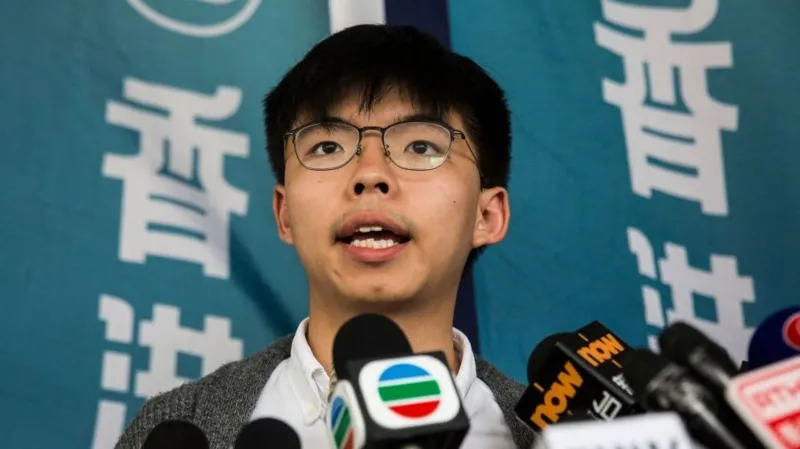
Hong Kong democracy activist Joshua Wong could spend several more years behind bars after pleading guilty to a second national security-related case in Hong Kong.
Wong, 29, appeared before the High Court on Wednesday after prosecutors accused him of conspiring with other activists to seek foreign sanctions against China and Hong Kong in 2020.
The case could result in a lengthy prison sentence, with the court empowered to impose a maximum penalty of life imprisonment.
Wong is already serving a four-year-and-eight-month sentence after pleading guilty in 2024 in a major national security trial involving dozens of Hong Kong opposition figures. He had been expected to leave prison in January.
Prosecutors told the court that Wong had campaigned with other activists for legislation in the United States that would enable Washington to impose sanctions on Hong Kong and Chinese officials.
The campaign involved social media activity and meetings with US politicians, including former House Speaker Nancy Pelosi and then-Senator Marco Rubio. Prosecutors also said the group sought sanctions from other countries.
According to the prosecution, the campaign, known as “International Battlefront,” continued after Beijing imposed Hong Kong’s National Security Law in 2020.
The United States subsequently sanctioned more than a dozen Hong Kong and Chinese officials.
During mitigation, Wong’s lawyer, Derek Chan, highlighted the activist’s lengthy time in custody, noting that he had spent six years in prison on various charges and had pleaded guilty in each case.
“He has had a lengthy opportunity to reflect on his action, to reflect on the path that he took,” Chan told the court.
The lawyer acknowledged that Wong could receive a sentence of up to 10 years but asked the judge to reduce it by half.
Chan urged the court to impose a sentence that “gives the defendant some hope and a future to look forward to that will not be crushing.”
The court adjourned the case and will deliver Wong’s sentence at a later date.
As he was taken from the courtroom, Wong waved at people in the public gallery and said, “Bye bye.”
A Hong Kong government spokesperson defended the prosecution and rejected international criticism of the case.
“The lawful exercise of free speech must not be conflated with taking actions to collude with a foreign country to impose ‘sanctions’ to harm one’s own country,” the spokesperson said.
Supporters rally around Wong
Tight security was reported around the court, with police officers registering and searching people waiting to enter the complex.
Among those who attended was Gloria Cheng, a 32-year-old friend of Wong, who said his prosecution reflected the wider political situation in the territory.
“This is not the first time for him and there were others before him,” she said.
“It really shows the state of affairs in Hong Kong now.”
Supporters said Wong has tried to remain positive while incarcerated by studying, exercising and learning to play the guitar.
Louis Lee, who has visited Wong in prison, said the activist was deeply distressed after learning he had been charged again under the national security law.
“We are very upset because no one would like to spend another day in prison,” Lee said.
From teenage protester to jailed activist
Wong first attracted international attention in 2012, when he was only 15.
He and other students organised sit-in protests against a government proposal to introduce Chinese civic education in Hong Kong schools.
The campaign eventually forced the government to withdraw the plan. Critics had argued that the proposed curriculum risked becoming propaganda promoting Beijing’s views.
The subject has since become compulsory in Hong Kong schools under the National Security Law.
In 2014, Wong became one of the prominent figures in the Umbrella Movement, a mass pro-democracy campaign that saw thousands of mostly young protesters occupy major roads across Hong Kong for 79 days while demanding greater democratic rights.
Known for his outspoken speeches, Wong later attempted to enter politics, but authorities repeatedly prevented him from standing for election.
He co-founded the pro-democracy political group Demosisto in 2016.
The party’s co-founder, Nathan Law, later entered Hong Kong’s Legislative Council as its youngest member, while Wong was barred from contesting because of his age.
Demosisto dissolved shortly after Beijing enacted the National Security Law.
Law subsequently left Hong Kong and is now among dozens of overseas democracy activists wanted by Hong Kong authorities, with bounties offered for information leading to their arrest.
Wong was again prevented from running in the 2020 elections.
He was later arrested alongside dozens of other opposition figures over their participation in unofficial primary elections.
The case, commonly referred to as the “47 case,” involved opposition figures who prosecutors accused of seeking to undermine the Hong Kong government through the primary election process.
Authorities described the primary as a “vicious plot” designed to “paralyze the government and undermine state power,” arguing that participants intended to use legislative powers to obstruct government legislation.
Most of the 47 defendants pleaded guilty, while 14 were convicted following the 2024 trial and received prison sentences of up to 10 years. Two defendants were acquitted.
Since the National Security Law came into force, several civil society organisations have disbanded and independent media outlets have closed.
Hong Kong’s legislature is now dominated by pro-Beijing lawmakers, while many prominent democracy advocates remain imprisoned or have gone into exile.
Last month, two leading organisers of Hong Kong’s former annual Tiananmen Square vigil were also convicted of inciting subversion.