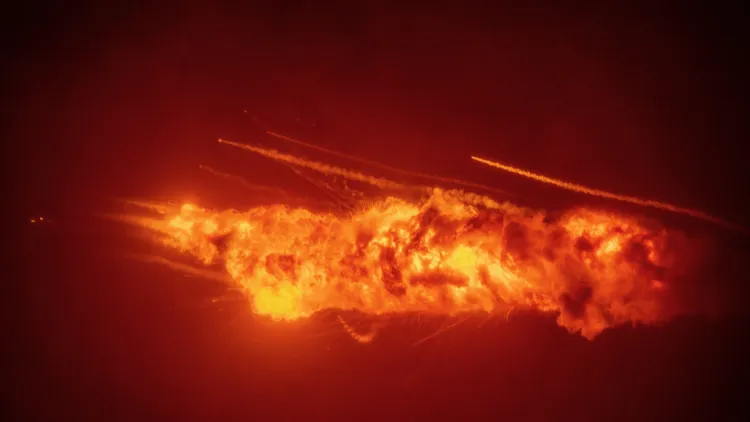
A Chinese Long March 7A rocket carrying a communications satellite exploded about 85 seconds after lifting off from the Wenchang Space Launch Site in Hainan on Monday, in a rare setback for the country’s space programme.
The rocket burst into a huge fireball shortly after its launch at about 8 p.m., according to footage of the incident.
China’s state-run Xinhua news agency confirmed the failed mission about three hours later, saying “the rocket experienced an anomaly during flight.”
It added that investigations were underway to determine the cause of the failure.
The incident received limited coverage in China’s state media, while videos shared by users on social media platforms were reportedly removed or became difficult to find.
The failed mission involved the Zhongxing-4B, also known as ChinaSat-4B, a satellite designed to provide radio, television and other communications services.
The Long March 7A, developed by the China Academy of Launch Vehicle Technology, a subsidiary of the state-owned China Aerospace Science and Technology Corporation, was undertaking its 18th mission.
It had previously recorded just one failure, during its maiden flight in 2020.
A subsequent launch in March 2021 was successful.
The setback comes as China continues to expand its space ambitions and compete with the United States in areas including satellite launches, lunar exploration and reusable rocket technology.
SpaceX founder Elon Musk, whose company has also experienced rocket failures, commented on X following the incident, saying: “Rockets are insanely hard.”
The failure also reportedly affected China’s plans for another major rocket launch.
The planned Tuesday morning launch of the Zhuque-3 from the Jiuquan Satellite Launch Centre was delayed, according to Shanghai-based financial outlet Yicai.
The Zhuque-3, developed by private Chinese company LandSpace, is being developed as a reusable launch vehicle and represents a key part of China’s efforts to advance reusable rocket technology.
The rocket made its first flight in December 2025, but its first stage caught fire before crashing near its intended recovery zone.
China achieved a major breakthrough with the vehicle last month when it successfully recovered the first stage during a subsequent test.
The booster landed on a floating platform about six minutes after separating from the rocket’s upper stage.
The Long March 7A, unlike the Zhuque-3, is not designed to be reusable.
It is a three-stage rocket measuring about 60 metres in length, with four boosters and the ability to carry up to seven metric tonnes of payload to geostationary transfer orbit.
Monday’s explosion is now under investigation, with Chinese authorities yet to disclose what caused the rocket to fail.