

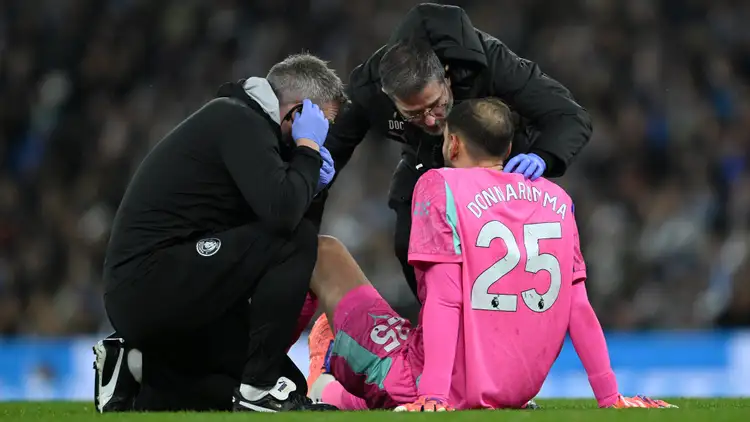
English football is set to introduce a major trial aimed at ending the growing use of goalkeepers to engineer tactical stoppages during matches, after the country’s leading football authorities agreed on a new disciplinary measure pending approval from the International Football Association Board.
The Premier League, Football Association,, English Football League, National League and Women’s Super League have all endorsed the proposal, which is intended to discourage teams from exploiting goalkeeper injuries to disrupt opponents’ momentum or create unofficial tactical breaks.
The initiative was developed in conjunction with Professional Game Match Officials Limited chief refereeing officer Howard Webb.
Under the proposed trial, if a referee allows medical staff onto the pitch to treat a goalkeeper, the manager will have 10 seconds to nominate an outfield player to leave the field for one minute.
The selected player’s identity must be communicated to the fourth official. If no player is nominated within the allotted time, the team captain will automatically be required to leave the pitch.
The move follows increasing criticism of what many believe has become a deliberate tactic in modern football.
Last season, several incidents reignited debate over goalkeepers going down injured to halt the flow of games and allow teammates to regroup.
Among the most notable cases came in November when Leeds United manager Daniel Farke accused Manchester City goalkeeper Gianluigi Donnarumma of feigning injury to “bend the rules” and break up play.
The growing frequency of such stoppages has fuelled demands from supporters, managers and pundits for a rule change.
Football authorities concluded that simply preventing players from approaching the technical area during injury breaks would not adequately address the problem, as coaches could still benefit from the interruption.
Match of the Day pundit Danny Murphy had previously argued that lawmakers already possessed a straightforward solution to the issue.
“I think they can change it really quickly,” Murphy said.
Despite the stricter approach, the proposed regulations include exceptions. Teams will not be required to send a player off the pitch if a goalkeeper indicates that medical treatment is unnecessary and play has not been stopped, or if the goalkeeper’s injury results from a collision with an outfield player.
Officials also clarified that players will still be free to approach the touchline while treatment is taking place.
However, they believe the prospect of temporarily playing with 10 players will be enough to discourage teams from using goalkeeper injuries as a tactical weapon.
Should IFAB grant approval in time, the trial is expected to make its debut during Saturday’s Carabao Cup preliminary-round fixture between Tranmere and Rochdale.
England’s proposal mirrors similar efforts elsewhere, with Australia’s A-League preparing to test a variation of the rule in which the team captain will always leave the field whenever a goalkeeper receives treatment.
While many have welcomed the initiative, some observers have expressed concerns about possible unintended consequences.
Critics argue that players may choose to remain on the pitch despite genuine injuries in order to avoid leaving their team temporarily short-handed.


