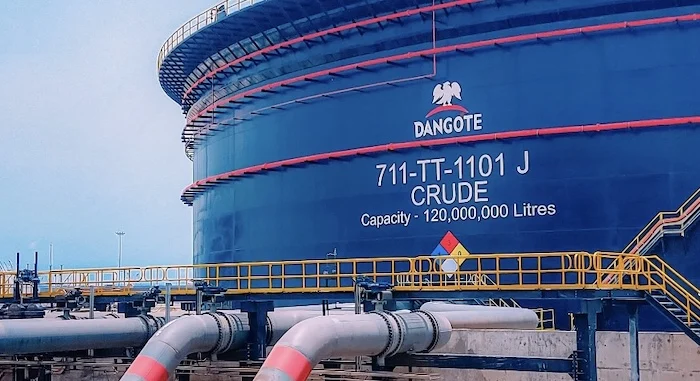
The Dangote Petroleum Refinery has taken delivery of two crude oil cargoes from the United Arab Emirates, marking the first time the facility has sourced crude from the Middle East as it seeks to broaden its supply base amid ongoing challenges with domestic crude availability.
A report by S&P Global Commodity Insights revealed that the shipments represent the first crude purchases by the 700,000-barrels-per-day refinery from a Middle Eastern supplier.
Until now, the refinery had largely depended on crude grades sourced from Nigeria, other African producers, and the United States.
According to the report, the acquisition was made possible by the resumption of oil exports from the Middle East following an interim peace agreement between the United States and Iran, which eased concerns over shipping disruptions through the Strait of Hormuz.
Although the refinery was built to primarily process Nigeria’s light sweet crude, it has increasingly diversified its feedstock sources as production activities expand.
S&P Global noted that a supply arrangement with the Nigerian National Petroleum Company guarantees the refinery between 13 and 15 cargoes of Nigerian crude each month in naira, helping to limit its exposure to foreign exchange fluctuations.
Despite the agreement, crude supply shortages and operational setbacks at export terminals have continued to affect deliveries.
The report recalled that Dangote Refinery Chief Executive Officer, David Bird, had previously acknowledged that these limitations forced the company to look beyond Nigeria for additional crude supplies.
The refinery’s future growth plans are also expected to drive higher crude demand. Dangote aims to increase the plant’s refining capacity to 1.4 million barrels per day by the end of 2028, a target that would allow it to process roughly 80 per cent of Nigeria’s current daily crude production.
Earlier this year, Bird disclosed plans to raise the proportion of heavier crude grades in the refinery’s feedstock mix.
“We definitely want to heavy up the barrel,” Bird said in April.
He added, “We will be in the crude blending game. So you can easily imagine at 1.4 million b/d we could process 30 per cent Middle Eastern grades on each train.”
S&P Global further reported that the refinery has continued to widen the range of crude grades it processes as part of its strategy to operate as a fully merchant refinery.
In 2025, Nigerian crude accounted for about 70 per cent of its imports, while crude sourced from the United States made up 24 per cent.