Authorities across Germany are dealing with a significant outbreak of poisonous caterpillars that has prompted the closure of several parks and public green spaces, including in Berlin, where the infestation has become especially severe.
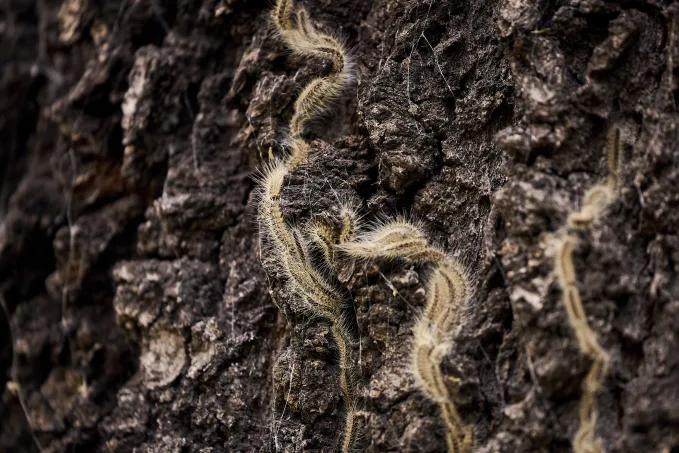
The oak processionary moth caterpillars carry microscopic barbed hairs filled with toxin. These hairs can trigger a range of health problems in humans, including skin rashes, eye irritation such as conjunctivitis, and breathing difficulties.
The hairs detach easily and can be carried by the wind over considerable distances, increasing the risk of exposure even without direct contact.
The insects also build distinctive white, silky nests on oak trees, which are themselves packed with the same hazardous hairs, adding to the danger in affected areas.
In Berlin, the outbreak has hit districts such as Charlottenburg-Wilmersdorf, Spandau and Friedrichshain-Kreuzberg particularly hard. Many popular parks in the city now resemble restricted zones, with warning tape and barriers put up to keep the public away.
One of the worst-affected locations is Wilhelm-von-Siemens-Park in Spandau, a 39-acre green space that authorities are advising people to avoid entirely. Nearby schools, childcare centres and surrounding streets have also been affected, according to Berlin’s official state and city government portal.
Specialised response teams wearing full protective suits have been deployed to remove the nests. Working from cherry pickers, they use vacuum equipment similar to that used in asbestos removal to extract the caterpillar nests from trees high above the ground.
A city official overseeing the operation told CNN that around 2,000 trees in the park are currently infested and sealed off. He also stressed that complete eradication is not possible, and that efforts are focused instead on reducing the risk in areas most used by the public.
According to the official, crews aim to clear about 20 trees daily, although infestation levels vary widely. In some cases, a single tree can take an entire day to treat; one team reportedly spent hours removing as many as 800 nests from one tree over a weekend.
Residents are being urged to take precautions after visiting parks, including washing clothing thoroughly and keeping doors and windows closed where possible.
Other German regions, including Hamburg and parts of North Rhine-Westphalia, have also reported outbreaks. These have been tracked by EPS-Radar, a digital mapping platform monitoring infestation spread.
The platform was created by designer Britta Wunderwald, who said she developed it with the help of an AI tool after a personal concern about exposure risk when a child in her circle showed symptoms linked to the caterpillars.
She noted that no similar up-to-date public map existed this year and expressed hope that authorities would take more proactive steps in future.
Urban nature specialist Derk Ehlert has warned residents through Berlin city communications not to approach the insects or their nests. He also noted that this year’s population appears higher than in previous seasons.
In earlier commentary on the Nature Conservation Foundation of Berlin website, he explained that the species originally came from southern Europe but has gradually expanded northwards over time.
The oak processionary moth tends to thrive in hot, dry conditions. Although it has long been present in Germany, experts say its increasing spread is being driven by climate change and is associated with broader biodiversity decline, according to EPS-Radar.
Exposure to the caterpillars’ hairs can cause itching, hives, respiratory distress, and in more serious cases, severe allergic reactions such as anaphylactic shock.