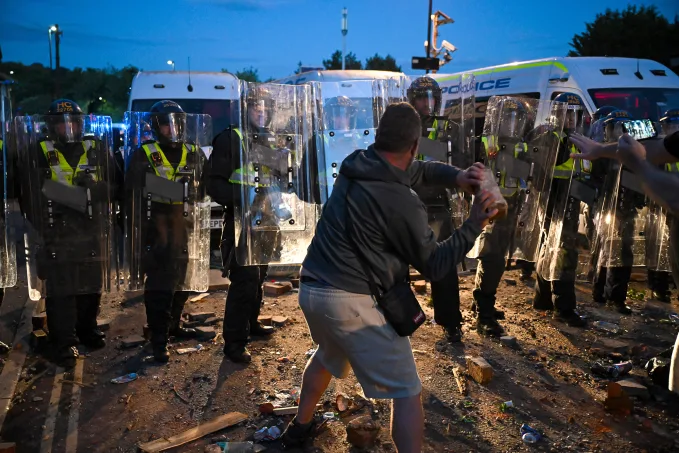
Clashes between United Kingdom police and protesters erupted in southern England following the death of a White university student who had been stabbed and later handcuffed by officers, an incident that has triggered a wave of national outrage and renewed political tension over policing, race, and public safety.
The unrest broke out on Tuesday evening outside a police station in Southampton, where hundreds of demonstrators gathered and were reportedly inflamed by far-right activists.
The situation escalated into violent confrontations with riot police, with bricks and other objects thrown, leaving 11 officers injured. Protesters were heard chanting “Henry, Henry,” in reference to 18-year-old Henry Nowak, a student who had been handcuffed by police as he lay dying from multiple stab wounds inflicted by Vickrum Digwa.
Digwa, a 23-year-old Sikh man, had falsely told officers he was the victim of a racist attack.
Shocking bodycam footage released by Hampshire Police showed Nowak in distress, repeatedly saying, “I can’t breathe” and “I’ve been stabbed.” An officer is heard responding, “I don’t think you have, mate.”
Digwa was later sentenced to life imprisonment on Monday, concluding a case that has since been widely cited by far-right figures seeking to frame it as evidence of institutional bias against White Britons in the UK.
That narrative has been strongly challenged by critics and official statistics. Data from government sources shows White defendants, on average, receive shorter custodial sentences than other ethnic groups, while Black prisoners serve a higher proportion of their original sentences compared to others.
Stop-and-search rates in London also show Black, Asian, mixed and other minority groups were more likely to be stopped last year.
The incident has unfolded against a backdrop of economic strain, political discontent, and rising tensions in parts of British society, creating what analysts describe as fertile ground for divisive narratives.
The controversy has also intensified ahead of a key by-election, with Nigel Farage’s Reform party and other political actors under scrutiny for their responses.
Prime Minister Keir Starmer condemned attempts to politicise the tragedy, saying, “Exploiting this tragedy to create grievance and division would be wrong in any circumstances, but to do it when the family are expressly saying ‘please don’t’ is unforgivable,” directing his criticism in part at Farage, who had said the public should respond with “pure cold rage.”
Henry Nowak’s father, Mark, also urged restraint outside court, stressing that he did not want his son’s death “to be used to create further division, hatred or tension,” while also calling for stronger action on knife crime.
“This is not a case about Sikhism. This is not a case about racism. This is a case about murder,” he said, according to UK news agency PA Media. “People should not be able to walk openly through the streets of Britain carrying a 21cm blade.”
Nowak, described as a freshman finance student, had been returning home from a night out with friends when he was attacked on December 3, 2025. Police said Digwa stabbed him five times, causing severe internal bleeding from a chest wound.
A pathologist later concluded that nothing could have saved his life even if officers had not handcuffed him.
Digwa claimed in bodycam footage that Nowak had pulled his turban and used racist language.
However, Sikh community leaders and others have strongly condemned the killing while urging against collective blame or community tension.
Political figures on the right quickly seized on the case. Farage wrote on X that the police response suggested “the fear of being called racist was greater than dealing with Henry Novak’s murder.”
His party also proposed policy changes aimed at rolling back what it described as anti-racist policing practices, arguing they had weakened law enforcement.
Those claims were rejected by former Metropolitan Police chief superintendent Dal Babu, who said, “I don’t accept the assertion that’s been made by far-right, anti-immigrant politicians,” adding, “We have with some politicians almost a two-tier citizenship issue here, where they express huge concerns when a person of color commits a crime against a White person, that they don’t do when a White person commits a crime against a person of color. These are all British citizens, they just happen to be a different skin color,” he said.
Babu also noted that Nowak should not have been handcuffed, saying officers should have separated those involved to properly assess the situation.
An independent investigation into the police handling of the incident is now underway, with Prime Minister Starmer telling lawmakers there are “serious questions to answer, including how accusations of racism informed police thinking.”
The fallout has extended beyond politics, with officials warning of rising online threats.
Home Secretary, Shabana Mahmood, revealed that one officer, who was not involved in the case, was wrongly identified online and forced to relocate after receiving death threats.
The case has echoed earlier incidents in which extremist groups and online networks have amplified criminal cases to advance broader political narratives, deepening tensions within already sensitive community relations in the UK.
In response, Sikh community representatives and Labour MPs issued a joint appeal for calm, saying, “At a time when emotions are understandably raw, we urge people not to allow the actions of one murderer to divide communities or fuel hostility towards innocent people.”
They added: “The Sikh community shares the grief, shock and anger felt across the country. We mourn Henry Nowak, stand with his family, and support truth, justice and accountability.”