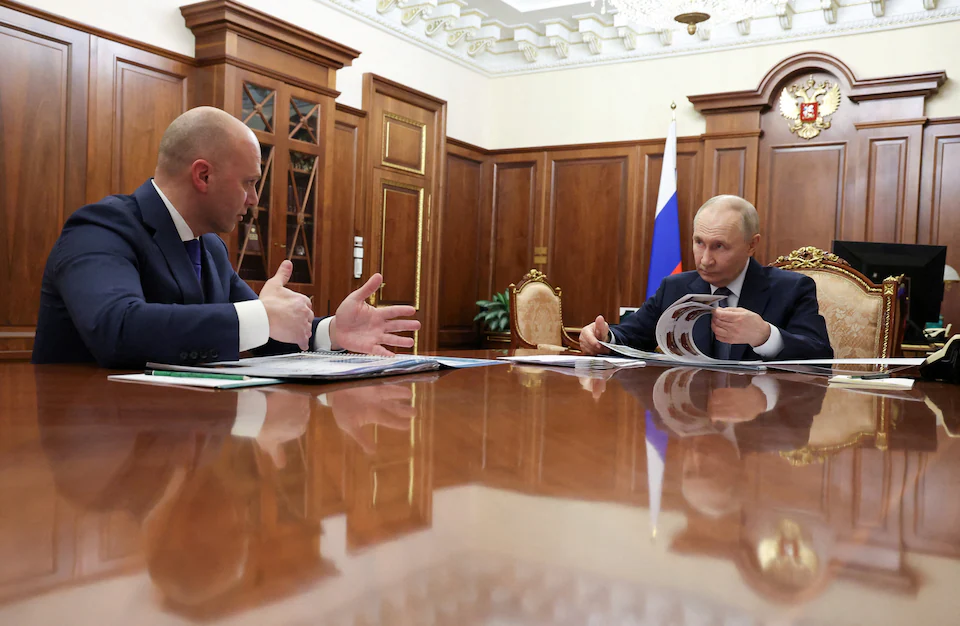
The Kremlin has significantly tightened personal security around President Vladimir Putin, including surveillance in homes of close staff and stricter controls on his entourage, according to a European intelligence dossier obtained by CNN.
Cooks, bodyguards, and photographers working with the president are now banned from public transport.
Visitors undergo double screening, and aides close to Putin are restricted to phones without internet access.
The measures were introduced in recent months following the killing of a senior general in December, which triggered tensions within Russia’s security elite.
The report says Russian officials have also reduced Putin’s travel locations, with him and his family reportedly no longer visiting usual residences in the Moscow region or the Valdai estate.
It adds he has not visited any military facility this year, unlike regular trips in 2025, and that the Kremlin sometimes releases pre-recorded footage to the public.
Since 2022, he has also spent extended periods in upgraded bunkers, often in the Krasnodar region.
“Russian security officials have drastically reduced the number of locations that Putin regularly visits,” the report says.
The dossier adds, “Since the beginning of March 2026, the ‘Kremlin and Vladimir Putin himself have been concerned about potential leaks of sensitive information, as well as the risk of a plot or coup attempt targeting the Russian president. He is particularly wary of the use of drones for a possible assassination attempt by members of the Russian political elite.’”
It also highlights internal tensions involving former defense minister Sergei Shoigu, saying he “is associated with the risk of a coup, as he retains significant influence within the military high command.”
It further states that the arrest of his former deputy Ruslan Tsalikov is seen as weakening Shoigu’s position.
Russia’s Investigative Committee said Tsalikov was arrested on charges including embezzlement, money laundering and bribery.
The report notes the intelligence may aim to signal instability within the Kremlin, while acknowledging verification challenges.
Some security measures have been previously reported, including heavy screening procedures and movement restrictions.
Putin continues to appear in public, recently meeting Chechen leader Ramzan Kadyrov and Iran’s foreign minister Abbas Araghchi.
He had already increased isolation during the Covid-19 pandemic, often meeting officials at long distances or via video link.
The report comes amid rising pressure from the war in Ukraine, including heavy Russian casualties, limited battlefield gains, and Ukrainian drone strikes reaching Moscow.
A recent drone strike reportedly hit a high-rise in western central Moscow.
Kremlin spokesman Dmitry Peskov said: “Against the backdrop of this terrorist threat, of course, all measures are being taken to minimize the danger.”
The dossier also describes internal disputes among Russian security chiefs following the December 2025 killing of Lieutenant General Fanil Sarvarov. It says a tense meeting saw accusations between the military and security services over failures in protection.
“Emphasizing the fear and demoralization this has caused among (military) personnel, Valeri Gerasimov strongly criticized his counterparts in the special services for their lack of foresight,” it says.
At the end of the meeting, “Vladimir Putin called for calm, proposing an alternative working format and instructing participants to present concrete solutions to the issue within one week.”
Following this, the Federal Protection Service was reportedly expanded to cover 10 additional senior commanders.
The report also notes adjustments to Russia’s May 9 Victory Day parade, with heavy weapons removed due to security concerns linked to Ukrainian long-range strikes.