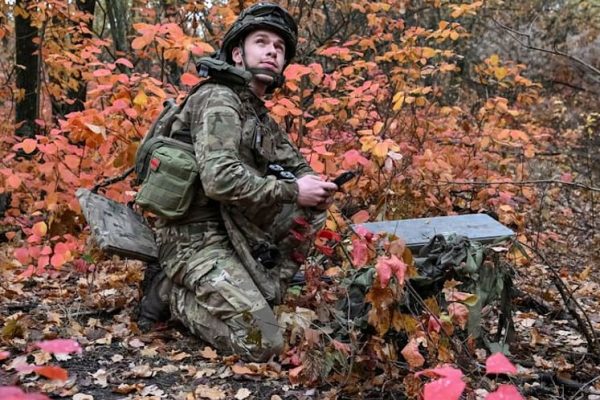
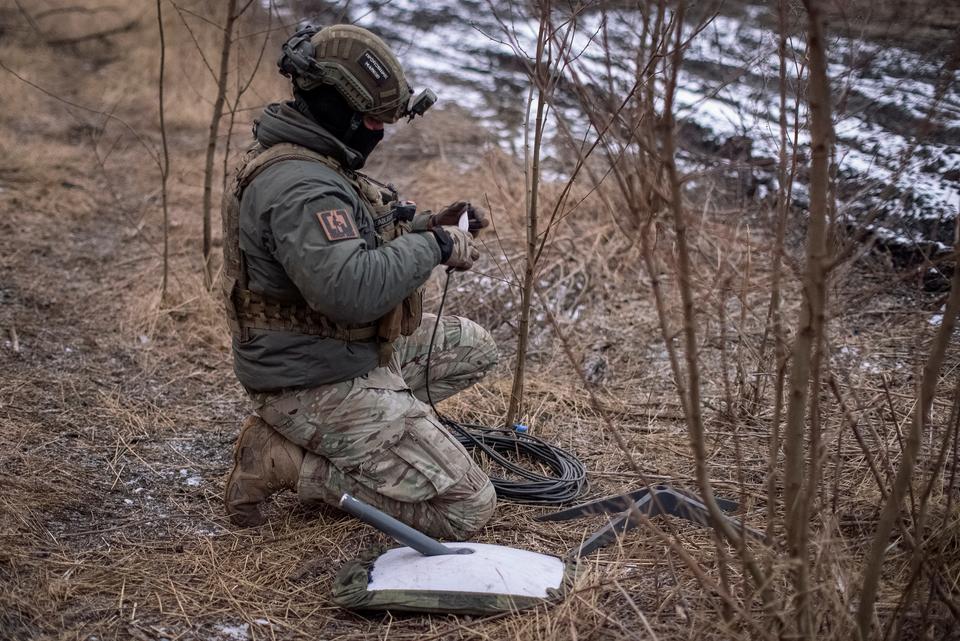
Ukraine is sending robots to the battlefield instead of humans, marking a dramatic shift in how modern wars are fought.
What once seemed like science fiction is now a reality on the front lines. In a striking example, two Russian soldiers were seen surrendering with their hands raised, not to human troops, but to Ukrainian-controlled land robots and drones operated remotely from miles away.
This moment highlights a growing transformation in warfare, where machines increasingly take on roles traditionally carried out by soldiers.
“The position was taken without a single shot being fired,” Mykola “Makar” Zinkevych, the commander of the Ukrainian unit that conducted the mission, told CNN.
Zinkevych, who serves in the “NC13” unit of Ukraine’s Third Separate Assault Brigade, which specializes in ground-based robotic strike systems, described the operation as unprecedented.
According to him, it was the first time an enemy position was captured and prisoners taken entirely through drones and ground robots, without any infantry involvement, a claim difficult to independently verify, but one that reflects Ukraine’s confidence in its technological edge.
Since that mission last summer, such robot-led operations have become routine for his unit.
For years, drones have dominated the skies over Ukraine’s front lines, making movement extremely dangerous for soldiers.
In response, Ukrainian forces began expanding into land-based robotics, remotely operated vehicles on wheels or tracks. Initially used for evacuations and resupply, these systems are now playing an increasingly active role in combat.
Unlike larger military vehicles, land drones are harder to detect and intercept. They can function in all weather conditions, carry heavier payloads, and operate for longer periods due to extended battery life.
In one instance late last year, a single ground robot armed with a machine gun reportedly held off a Russian advance for 45 days, requiring only minimal maintenance and periodic recharging.
“We must understand that we will never have more personnel, and we will never have a numerical advantage over the enemy,” Zinkevych said. “So, we need to achieve this advantage through technology.”
He added that Ukraine aims to replace up to a third of its infantry forces with drones and robotic systems within the year.
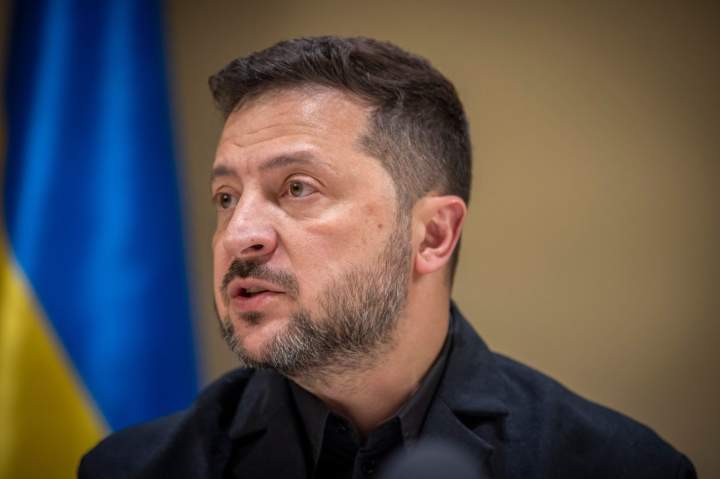
Ukrainian President Volodymyr Zelensky recently underscored the scale of this shift, revealing that more than 22,000 missions had been carried out by drones and robots in just three months.
“Lives were saved more than 22,000 times when a robot went into the most dangerous areas instead of a warrior,” Zelensky said in a speech highlighting the country’s military tech achievements.
Experts say these developments could redefine the future of warfare. Robert Tollast, a land warfare specialist at the Royal United Services Institute in the UK, noted that while ground robots may struggle to hold territory on their own, they are already proving invaluable.
“These systems are now regularly saving the lives of soldiers in casualty evacuation, dangerous resupply missions, mine clearance and increasingly, fighting,” he said, adding that their role will likely expand across other militaries globally.
The rapid evolution of drone warfare has pushed Ukraine to the forefront of military innovation. This progress has accelerated further under Defense Minister Mykhailo Fedorov, who has prioritized technology and data-driven strategies to counter Russia’s larger forces.
Ukraine’s plan includes building a high-tech defensive network capable of identifying and intercepting most aerial threats in real time, while also establishing a continuous “kill zone” along the front line where drones and robots operate relentlessly.
Zinkevych emphasized that success in this new era of warfare depends not just on innovation, but on scale.
“On the battlefield, the decisive factor is not who invented the technology and (figured out) how to apply it, but who has managed to scale it up over the long term,” he said.
Analysts believe Ukraine’s growing dominance in drone warfare has already slowed Russian advances and helped Kyiv regain momentum in certain areas.
Beyond the battlefield, Ukraine is now leveraging its expertise internationally. Countries in the Middle East, facing costly challenges in countering cheap drones, have shown interest in Ukraine’s more efficient solutions. In turn, Kyiv is seeking critical military support, including air defense systems.
Looking ahead, artificial intelligence is expected to play a major role in the next phase of military technology. However, there are concerns about fully autonomous weapons.
“The final decision must always be made by a human,” Zinkevych said. “Would you entrust weapons to artificial intelligence? How can we be sure it will be able to distinguish a friend from a foe? How can we be sure there won’t be a malfunction or that something won’t go wrong?”
Reflecting on how quickly things have changed, he admitted the idea once sounded unbelievable.
“If I had heard myself speaking like this back in 2022, I would have said that some madman was talking… it was all just science fiction,” he said.
Now, however, his stance is clear.
“Human life is priceless, whereas robots do not bleed. Based on this, my position is that robotic ground systems need to be developed much faster, on a much larger scale, and implemented as a global system for use on the battlefield.”