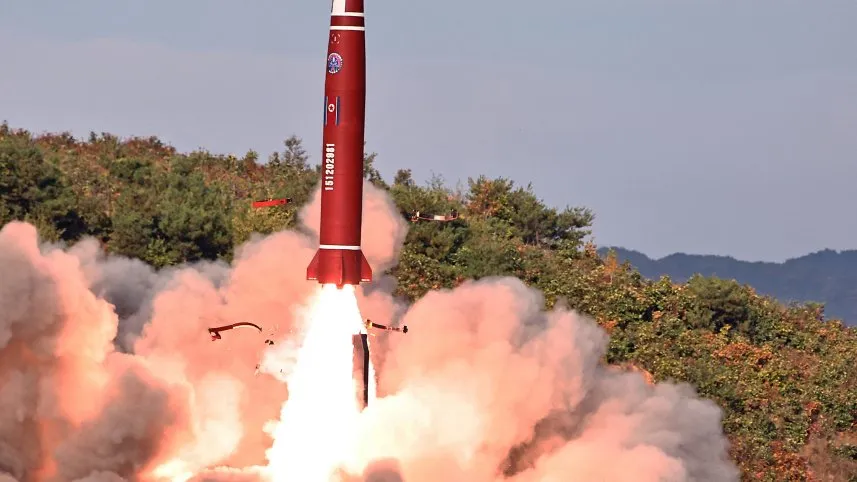
North Korea launched multiple short-range ballistic missiles in two waves on Wednesday, South Korea’s military reported, following the previous day’s launch of an “unidentified projectile” from the Pyongyang area.
Since taking office last year, South Korean President Lee Jae Myung has sought to mend relations with the North.
On Monday, Seoul expressed regret over civilian drone incursions into North Korea in January, with Lee calling the operation “irresponsible” and noting that government officials had been involved.
However, analysts said Wednesday’s missile launches, North Korea’s fourth and fifth known ballistic missile tests this year, highlighted Pyongyang’s rejection of Seoul’s peace overtures.
South Korea’s military confirmed early Wednesday that an “unidentified projectile” had been fired from near North Korea’s capital the day before.
About an hour later, it reported detecting “multiple unidentified ballistic missiles” launched from the Wonsan area toward the East Sea, also known as the Sea of Japan.
The first batch of short-range ballistic missiles was fired around 8:50 am (2350 GMT Tuesday), traveling approximately 240 kilometres (149 miles), while another missile was launched at 2:20 pm, flying over 700 kilometres.
The Japan Coast Guard also warned that “an object suspected to be a ballistic missile has been launched from North Korea,” urging ships to “remain vigilant.”
Seoul’s Office of National Security convened an emergency meeting at the Blue House, demanding Pyongyang immediately halt provocations.
After Lee’s statement of regret on Monday, Kim Yo Jong, the influential sister of North Korean leader Kim Jong Un, called the gesture “wise behaviour.” She said, “Our government appreciated it as very fortunate and wise behaviour for its own sake.”
Yet on Tuesday, a senior North Korean official labeled South Korea “the enemy state most hostile” to Pyongyang, reviving a term previously used by Kim Jong Un.
Jang Kum Chol, first vice-minister of Pyongyang’s foreign ministry, dismissed South Korean media reports portraying Kim Yo Jong’s comments as “an exceptional friendly response,” calling them “nonsense.”
He added that such an interpretation was nothing more than “hope-filled dream reading” by “world-startling fools,” according to the state-run Korean Central News Agency.
“The launches were Pyongyang’s message to Seoul that its anti-South stance remains firm despite Seoul’s repeated overtures,” said Lim Eul-chul, a North Korea expert at Kyungnam University.
Later Wednesday, Pyongyang state media announced that China’s top diplomat, Wang Yi, would visit the North on a two-day trip starting Thursday.
His visit precedes an expected summit between US President Donald Trump and Chinese President Xi Jinping next month, fueling speculation about a possible meeting between Trump and Kim around the same time.
Trump, who has criticized South Korea’s support for the U.S. war in Iran, recently praised his relationship with Kim, saying, “South Korea didn’t help us during the Middle East war. We’ve got 45,000 soldiers in South Korea to protect (them) from Kim Jong Un, who I get along with very well. He said very nice things about me.”
In reality, the United States maintains approximately 28,500 troops in South Korea. Trump met Kim three times during his first term, but his October remark that he was “100 percent” open to meeting Kim again has not received a response.