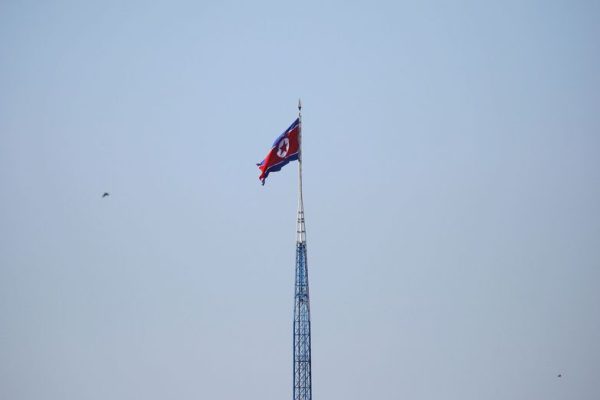
South Korea’s military reported on Saturday that North Korea has started removing some of its loudspeakers from the inter-Korean border, shortly after Seoul took down its own frontline speakers used for anti-North Korean propaganda broadcasts in an effort to reduce tensions.
The South Korean Joint Chiefs of Staff did not specify the exact locations where the North was dismantling its speakers, and it remains unclear if Pyongyang plans to remove all of them.
Residents living near the border have recently voiced complaints about North Korean loudspeakers broadcasting disturbing noises, such as howling animals and pounding gongs, in retaliation to South Korean propaganda efforts.
The South Korean military noted that North Korea ceased its broadcasts in June, following President Lee Jae Myung’s decision to suspend Seoul’s loudspeaker transmissions as a key gesture to ease strained relations between the two nations.
South Korea began dismantling its speakers at the border earlier this week but has not disclosed how these devices will be stored or whether they could be quickly reinstalled if tensions flare up again.
North Korea, known for its sensitivity to external criticism of its authoritarian regime under leader Kim Jong Un, has not yet confirmed the removal of its speakers.
In 2024, under a conservative government, South Korea resumed daily loudspeaker broadcasts in June as a response to North Korea sending trash-filled balloons across the border.
These broadcasts featured propaganda and K-pop songs deliberately chosen to provoke Pyongyang, where Kim Jong Un has launched a campaign to eradicate South Korean pop culture and language influence to reinforce his family’s dynastic control.
These psychological warfare tactics have escalated tensions, already heightened by North Korea’s nuclear advancements and Seoul’s increasing military drills with the United States and trilateral cooperation with Japan.
President Lee, who assumed office in June after an early election replacing ousted conservative Yoon Suk Yeol, aims to foster better relations with North Korea, which rejected dialogue under Yoon’s tough stance.
However, Kim Yo Jong, the powerful sister of Kim Jong Un, dismissed Lee’s efforts in late July, criticizing Seoul’s “blind trust” in its alliance with Washington and equating it with previous conservative policies.
She also responded skeptically to the Trump administration’s earlier diplomatic attempts to denuclearize North Korea, hinting that Pyongyang, now prioritizing closer ties with Russia amid the Ukraine conflict, sees no pressing reason to engage in talks with either Seoul or Washington.
Tensions could escalate again later this month when South Korea and the United States conduct their annual large-scale joint military exercises starting August 18.
North Korea routinely condemns these drills as rehearsals for invasion and frequently uses them as justification for military demonstrations and weapons testing aimed at advancing its nuclear capabilities.