North Korea has expressed support for Iran’s decision to appoint a new supreme leader, while accusing the United States and Israel of threatening peace in the region, according to state media reports on Wednesday.
Pyongyang, which has long been at odds with Washington, previously condemned the US-Israeli attack on Iran, describing it as an “illegal act of aggression”.
Iran on Sunday named Mojtaba Khamenei as its new supreme leader, succeeding his father, Ali Khamenei, who was killed in an Israeli airstrike on February 28.
The move came despite US President Donald Trump’s stated interest in influencing Iran’s leadership transition.
Reacting to the development, an unnamed spokesperson from North Korea’s Foreign Ministry said the country respects Iran’s internal decision.
“We respect the rights and choice of the Iranian people to elect their supreme leader,” the spokesperson said in remarks carried by the Korean Central News Agency.
The official also accused Washington and Tel Aviv of destabilising the region, stating that the United States and Israel are “destroying the regional peace and security foundations and escalating instability worldwide”.
According to the spokesperson, both countries have violated Iran’s “political system and territorial integrity” while attempting to “overthrow its social system”.
Such conduct, the official said, “deserve worldwide criticism and rejection as they can never be tolerated”.
For decades, Washington has led international efforts to dismantle North Korea’s nuclear programme, relying on sanctions, diplomacy and high-level summits that have so far yielded limited results.
Recently, however, the Trump administration has sought to restart high-level engagement with Pyongyang, with the possibility of a new meeting between Trump and North Korean leader Kim Jong Un later this year.
During a visit to Asia in October, Trump said he was “100 percent” willing to meet Kim again, though the North did not immediately respond.
After months of silence, Kim later suggested that both nations could “get along” if the United States acknowledged North Korea as a nuclear power.
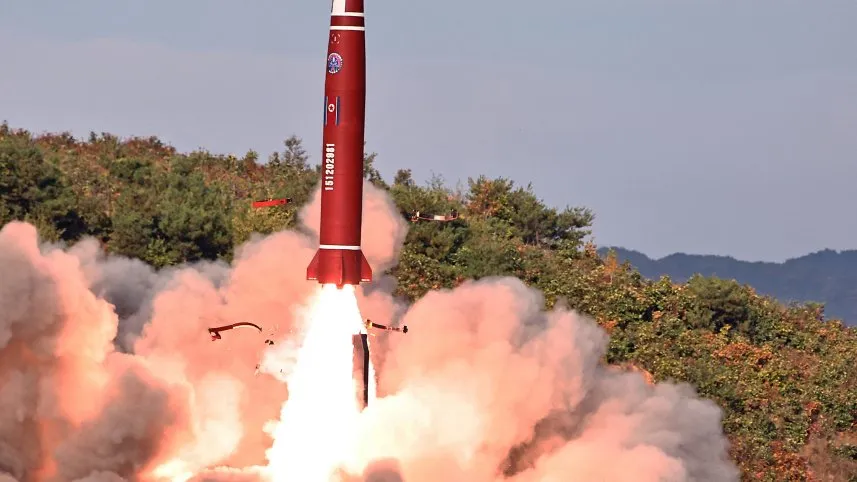
Meanwhile, North Korea’s state media also reported that Kim supervised another test-launch of strategic cruise missiles from the naval destroyer Choe Hyon.
The country conducted a similar test from the same vessel last week, claiming it was working toward “arming the Navy with nuclear weapons”.
KCNA reported that Kim emphasised the need to strengthen a “powerful and reliable nuclear war deterrent” during the launch.
Photographs released by state media showed the leader monitoring the launch via video feed alongside his teenage daughter, Ju Ae, who is widely seen as a potential successor.
Kim said the country had achieved “important successes” in the operational deployment of “strategic and tactical strike means”.
South Korea’s intelligence agency has indicated that Pyongyang may be preparing Ju Ae for future leadership, pointing to frequent public appearances with her father during official engagements.
The latest missile test coincided with the start of the annual “Freedom Shield” military exercises between the United States and South Korea, which began on Monday.
Pyongyang reacted strongly to the drills, warning they could trigger “unimaginably terrible consequences”.
The Choe Hyon is one of two 5,000-ton destroyers in North Korea’s fleet, both introduced last year as part of Kim’s efforts to strengthen the navy with short-range tactical missiles capable of carrying nuclear warheads.
Yang Moo-jin, former president of the University of North Korean Studies, said the missile activity signals Pyongyang’s intention to reinforce its deterrence posture.
North Korea appears to be “securing the legitimacy and justification for bolstering war deterrence,” Yang told AFP.
He added that Pyongyang is portraying the US-South Korea joint drills as more than routine exercises, presenting them instead as potential preparations for a preemptive strike.