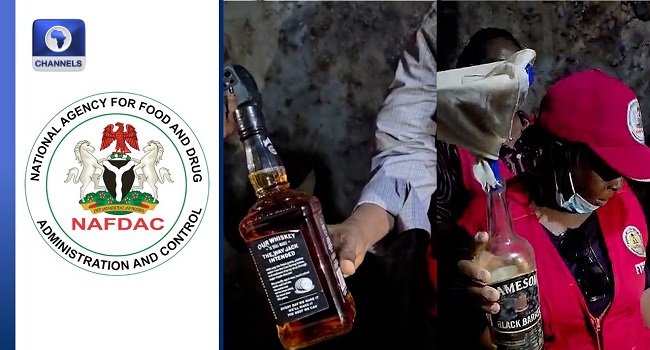
The Distillers and Blenders Association of Nigeria, on Friday morning, led a coalition of stakeholders, including the Nigeria Labour Congress, Trade Union Congress and workers from various companies, to the Lagos office of the National Agency for Food and Drug Administration and Control to protest the ban on the manufacture and sale of alcoholic beverages in sachets.
The protesters, who arrived at the agency’s premises as early as 8:30 a.m., carried placards with messages appealing to the Federal Government to intervene, emphasizing the potential negative impact on the nation’s economy and the livelihoods of millions of Nigerians connected to the sector.
Some of the placards read, “Local manufacturers deserve protection, not frustration,” “Stop destroying local manufacturers,” “N2 trillion investment deserves protection,” “5.5 million Nigerians cannot be pushed to the streets,” and “The Renewed Hope Agenda must work for all Nigerians.”
Executive Secretary of the Food, Beverage and Tobacco Senior Staff Association, a union under TUC, Comrade Solomon Adebosin, explained to journalists that the protest became necessary following NAFDAC’s move to enforce the ban on alcohol in sachets and PET bottles below 200ml, despite directives from the office of the Secretary to the Government of the Federation to suspend all actions related to the ban pending consultations and a final directive.
On Wednesday, NAFDAC announced the commencement of enforcement of the ban on the production and sale of alcohol packaged in sachets and PET bottles nationwide.
According to Adebosin, the policy threatens over five million jobs and puts at least N3 trillion in investment at risk.
“At this period of our economy, throwing over five million people out of their jobs and putting at least 3 trillion investment at risk, will not augur well for our country. We appreciate our president for his various pro-active measures to strengthen the economy, killing local investments and throwing people out of jobs will definitely frustrate President’s commitment to boost the economy,” he said.
He further emphasized that the ban disproportionately targets indigenous producers, who are the most affected.
“With the trend and the target of the ban, it is clear that it meant to frustrate local manufacturers out of the market. Unfortunately, this will have multiple negative effects on the economy as all the people engaged in the value chain of sales and production would be affected,” he added.
Adebosin called for proper regulation through access control and advocacy, pointing out that such measures are globally accepted as a sustainable approach.
He urged NAFDAC to adopt these methods rather than a ban that could cause widespread economic disruption.
Also speaking during the protest, Comrade Azeez Rasaki, representing the National Union of Food, Beverages & Tobacco Employees, said the enforcement undermines the Tinubu Administration’s economic recovery goals and runs contrary to the Renewed Hope Agenda, which aims to create jobs, stimulate industrial growth, and support local enterprises.