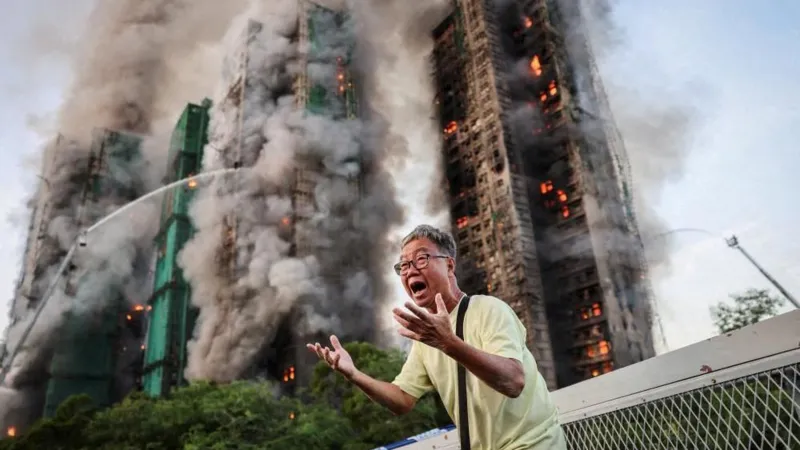
The death toll from Hong Kong’s most devastating fire in nearly eight decades has climbed to 128, with around 200 people still reported missing from the high-rise housing estate consumed by flames, the city’s security chief confirmed on Friday.
The blaze tore through the Wang Fuk Court residential complex, eight 32-storey towers located in Tai Po, after erupting on Wednesday afternoon and spreading rapidly.
Hong Kong Security Chief Chris Tang, speaking at a press conference, warned that the numbers could rise.
“We do not rule out the possibility that more bodies could be discovered when police enter the building for detailed investigations,” he said, noting that only 39 of the confirmed dead had so far been identified.
Tang also revealed that the building’s fire alarms had malfunctioned. Rescue operations have now ended, with at least 79 people injured, including 12 firefighters.
“Our aim now is to make sure the temperature decreases in the building and once everything is deemed safe, police will collect evidence and conduct further investigation,” he added.
The estate, home to more than 4,600 residents, had been surrounded by bamboo scaffolding and wrapped in green mesh as part of ongoing renovation works.
Police have arrested three officials from a construction firm on suspicion of manslaughter, accusing them of using unsafe materials such as flammable foam panels that blocked windows.
Fear, grief and unanswered questions
Authorities acknowledged that residents had repeatedly complained about fire hazards linked to the renovations.
The Labour Department told Reuters that in September 2024, residents questioned the flammability of the protective green mesh covering the scaffolding. Despite this, they were later told the fire risk was “relatively low.”
As firefighters finally extinguished the smouldering towers on Friday, grieving families faced the painful task of trying to identify loved ones through photographs taken by emergency crews.
Mirra Wong, whose parents lived in Wang Fuk Court, said she was still searching for her father. “Just recognise some picture is maybe (the) body of my dad. It’s my dad’s body is still missing here,” said the 48-year-old.
Another resident, who asked not to be named, said a friend’s wife was among the missing. “Rationally speaking, it means there’s no hope,” she said. “But the bodies still have to be found, right? Let me see if they’ve found them … It’s just too sorrowful. When it involves people you know, it’s even more painful.”
This tragedy is now the city’s deadliest fire since 1948, when 176 lives were lost in a warehouse inferno.
Migrant workers among the casualties
Dozens of Filipino domestic workers were affected, and 19 remain unaccounted for, according to Edwina Antonio of Bethune House, a refuge for migrant women.
Indonesia’s consulate reported that two Indonesian domestic workers were among the dead. Hong Kong is home to about 368,000 domestic workers, mostly women from low-income Asian countries, who typically live with their employers.
Construction firm under investigation
Police arrested two directors and an engineering consultant from Prestige Construction, the company responsible for the estate’s year-long maintenance project.
Superintendent Eileen Chung said investigators believed the firm’s leadership exhibited gross negligence.
“We have reason to believe that the company’s responsible parties were grossly negligent, which led to this accident and caused the fire to spread uncontrollably, resulting in major casualties,” she said.
Authorities seized company documents, employee lists, 14 computers and three mobile phones during a raid on its office. Prestige has not responded to calls for comment.
Amid safety concerns, Hong Kong’s development bureau announced it is considering phasing out bamboo scaffolding in favour of metal alternatives.
Government response and displaced residents
Hong Kong leader John Lee pledged a HK$300 million (US$39 million) relief fund for affected residents. Several major Chinese companies also announced donations.
With their homes uninhabitable, dozens of evacuees spent a second night sleeping in a nearby mall, using tents, duvets and donated supplies. Some declined to occupy official shelters, saying others were in greater need.
“We don’t know when we can go home. We have to wait for the police to notify,” said an elderly evacuee, who identified himself only as Cui. “Wang Fuk Court is burning badly, we are afraid that it is dangerous to go home … I am anxious, I cannot sleep well here.”
As one of the world’s most densely populated cities, Hong Kong’s dependence on high-rise estates has long been a source of public frustration due to steep housing costs.
Analysts warn that the disaster could intensify public discontent, even as officials move quickly to demonstrate attention and control.
Beijing and Hong Kong authorities have both signaled that they view the incident as a critical moment for the city’s governance and public trust.