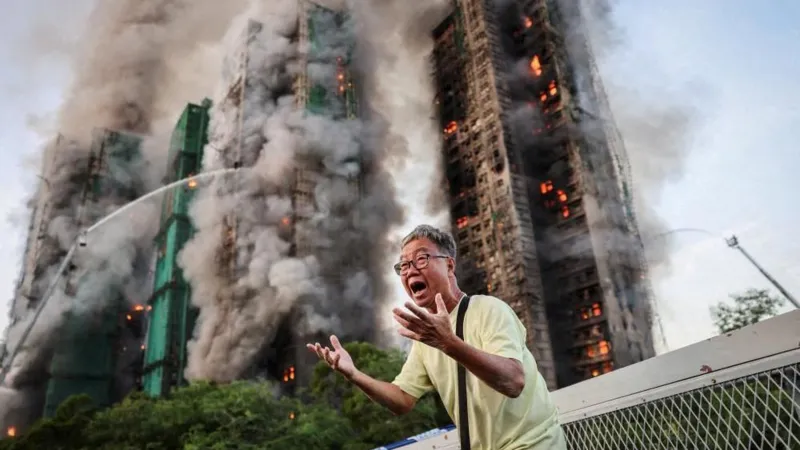
Death toll rose to at least 44 in the massive Hong Kong apartment blaze still burning through parts of the Wang Fuk Court complex, as nearly 300 residents remain unaccounted for.
Police said on Thursday that the inferno may have been fuelled by unsafe scaffolding and foam materials used during ongoing maintenance work.
Fire crews worked overnight but continued to struggle to reach people believed to be trapped on upper floors, battling intense heat and thick smoke after the fire erupted on Wednesday afternoon in the tightly packed Tai Po housing estate.
The sprawling development contains 2,000 apartments across eight towers and is home to more than 4,600 residents.
By early Thursday, authorities said four blocks were largely under control, though operations remained active in three others.
Video footage showed flames still shooting from at least two of the 32-storey towers wrapped in bamboo scaffolding and green mesh, with heavy smoke rising into the sky.
Police said they found that some protective mesh and plastic sheeting around the buildings may have failed to meet fire standards.
They also discovered windows sealed with foam material in one block untouched by the blaze, work allegedly carried out by the construction firm handling the renovations.
“We have reason to believe that the company’s responsible parties were grossly negligent, which led to this accident and caused the fire to spread uncontrollably, resulting in major casualties,” said police superintendent Eileen Chung.
Three men from the construction company, including two directors and an engineering consultant—were arrested on suspicion of manslaughter.
The green mesh and bamboo scaffolding, while traditional in Chinese construction, have been under phased removal in Hong Kong since March due to safety concerns.
A firefighter was among the 44 people confirmed dead, while 45 others remain in critical condition.
The tragedy is now Hong Kong’s deadliest fire since 1948, surpassing the 41 deaths recorded in a 1996 Kowloon commercial building blaze.
Comparisons have emerged with London’s 2017 Grenfell Tower disaster, where flammable cladding and regulatory failures contributed to the deaths of 72 people.
“The priority is to extinguish the fire and rescue the residents who are trapped,” said Hong Kong leader John Lee. “The second is to support the injured. The third is to support and recover. Then, we’ll launch a thorough investigation.”
Lee said some 279 residents remained uncontactable, while 900 had taken refuge in temporary shelters. Deep anguish gripped survivors, including a 71-year-old man surnamed Wong who wept as he said his wife was still inside.
Another resident, 66-year-old Harry Cheung, said he heard a loud bang around 2:45 p.m. before seeing flames erupt nearby.
“I immediately went back to pack up my things,” he said. “I don’t even know how I feel right now. I’m just thinking about where I’m going to sleep tonight.”
A 70-year-old woman surnamed Chu said she had been unable to reach friends living in the next block. Returning Thursday morning after staying with a friend, she found her home still ablaze. “We don’t know what to do,” she said.
From Beijing, President Xi Jinping urged an “all-out effort” to extinguish the fire and minimise casualties, according to state broadcaster CCTV.
Social media comments from residents accused the construction firm of negligence and cost-cutting, with one circulating video showing workers smoking atop the bamboo scaffolding during the renovation period.
Road closures, bus diversions, and school shutdowns affected the area as emergency crews continued battling the blaze. Frames of scaffolding were seen collapsing to the ground as dozens of fire engines and ambulances crowded the streets.
Although fire risk wasn’t the reason behind the policy change, bamboo scaffolding has been involved in at least three fires this year, according to the Association for the Rights of Industrial Accident Victims.
The government’s phased replacement will see half of all public construction projects switching to metal frames.
The fire comes against a backdrop of long-standing frustration over Hong Kong’s housing conditions, an issue that could intensify political tensions ahead of the December legislative elections.
Wang Fuk Court, built in 1983 and part of the government’s subsidised home-ownership programme, has been undergoing a year-long HK$330 million renovation, with residents paying between HK$160,000 and HK$180,000 per unit.