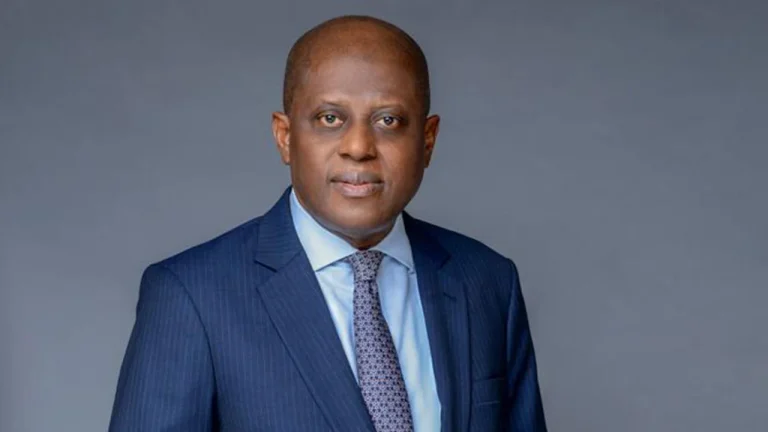
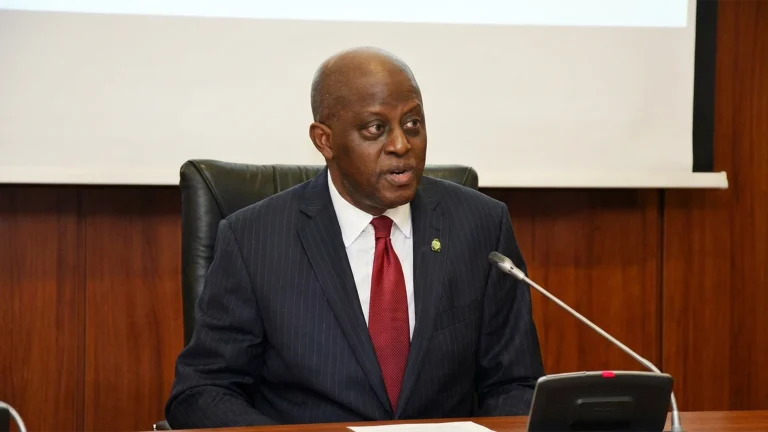
The Governor of the Central Bank of Nigeria, Olayemi Cardoso, has announced that Nigeria’s trade surplus has climbed to 6% of the nation’s Gross Domestic Product, a level he expects to be sustained in the near term.
Cardoso attributed the improvement in the country’s balance of trade to the Federal Government’s consistent implementation of sound macroeconomic policies, which he said are beginning to produce tangible results.
This revelation was contained in a press statement issued by the Director of Information and Public Relations at the Federal Ministry of Finance, Mohammed Manga.
According to the statement, Cardoso made the disclosure while representing the Minister of Finance and Coordinating Minister of the Economy, Wale Edun, at the G-24 press briefing held on the sidelines of the IMF/World Bank Annual Meetings in Washington, D.C.
The statement highlighted that Cardoso, who spoke alongside the Minister of State for Finance, Dr. Doris Uzoka-Anite, emphasized Nigeria’s resilience amid global economic uncertainties.
Manga stated, “As the world watches, Nigeria’s economic prospects are shining brighter, with the Honourable Minister of State for Finance, Dr. Doris Uzoka-Anite, joining the Governor of the Central Bank of Nigeria (CBN), Mr. Olayemi Cardoso, as part of the Nigerian delegation at today’s G24 meetings on the sidelines of the IMF/World Bank Annual Meetings in Washington D.C. The meetings provided a platform for discussions on key themes such as domestic resource mobilization, inflation, and sound macroeconomic policies.
“During the meetings, Cardoso disclosed that Nigeria’s trade surplus has risen to 6% of the nation’s Gross Domestic Product (GDP) and is expected to remain at that level in the near term. He attributed the improved balance of trade to sound macroeconomic policies that are beginning to yield positive results.
“The CBN Governor also highlighted the importance of maintaining sound macroeconomic policies, noting a strong correlation between disciplined economic management, growth, and disinflation. He further disclosed that the apex bank is working on a framework to make currency swaps with other countries a win-win affair.”
Cardoso further noted that Nigeria’s economy is undergoing a complete restructuring, driven by a more competitive currency that encourages local production while discouraging imports.
The statement also pointed out that Dr. Uzoka-Anite’s participation in the G24 meetings reflects the Nigerian government’s commitment to engaging with international financial institutions and partners to sustain economic growth and development.
Her involvement, it added, underscores the administration’s proactive efforts to strengthen global cooperation and dialogue.
“The meetings mark a significant step forward for Nigeria’s economic growth and development, as the country continues to engage with international financial institutions and stakeholders to drive progress and improve the lives of its citizens,” the statement concluded.
What you should know:
According to an earlier report by the National Bureau of Statistics (NBS), Nigeria’s trade surplus surged by 44% in the second quarter (Q2) of 2025.
The NBS report revealed that total merchandise trade reached N38.04 trillion in Q2 2025 — a 20.05% rise from N31.68 trillion recorded in the same period of 2024, and a 5.59% increase from N36.02 trillion in the preceding quarter.
Exports accounted for 59.81% of total trade, valued at N22.75 trillion — a 28.43% increase from N17.71 trillion in Q2 2024 and 10.45% higher than the N20.60 trillion recorded in Q1 2025.
Crude oil exports contributed N11.97 trillion (52.6% of total exports), while non-crude oil exports stood at N10.78 trillion (47.4%). Non-oil products accounted for N3.05 trillion, representing 13.39% of total exports.
Imports, on the other hand, made up 40.19% of total trade at N15.29 trillion, showing a 9.43% increase from N13.97 trillion in Q2 2024 but a slight 0.90% decrease compared to N15.43 trillion in Q1 2025.