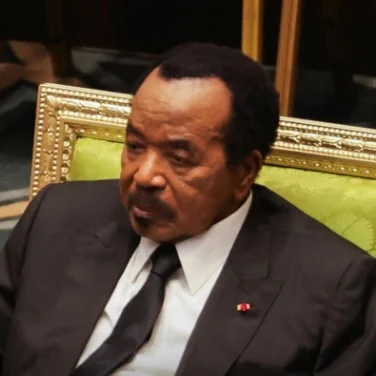
Cameroonians went to the polls on Sunday in an election that could extend the decades-long rule of President Paul Biya, Africa’s and the world’s oldest sitting leader, by another seven years.
Now aged 92, Biya has led the Central African nation since 1982, when he succeeded the country’s first president, Ahmadou Ahidjo.
Since then, he has won seven elections, keeping an unbroken grip on power. If re-elected, Biya would be 99 by the time his new term ends.
Despite his long dominance, growing doubts are emerging about his health and leadership.
The president reportedly spends much of his time in Europe, leaving core state functions to trusted family members and senior officials.
Dr. Benjamin Akih, an activist and professor at Syracuse University, suggested that Biya’s advanced age and lengthy tenure could work against him this time.
“I think this election is different. Mr. Biya was the weakest candidate the CPDM could put forward on account of his age and the poor state of the country after his 43 years in power,” he said.
Announcing his decision to seek another term, Biya said, “In the face of increasingly difficult international environment, the challenges facing us are more and more pressing. In such a situation, I cannot shirk my mission.”
Biya is contesting against nine challengers, including former allies turned rivals such as Bello Bouba Maigari, a onetime tourism minister, and Issa Tchiroma Bakary, the former minister of employment.
The longtime leader cast his vote at a primary school in Yaounde, the capital, but declined to discuss his plans.
“He wouldn’t comment on his plans until the results were in,” local reporters noted. Official results are expected no later than October 26.
Opposition figure Joshua Osih, the Social Democratic Front’s presidential candidate and a member of parliament who placed fourth in 2018, voiced concerns about irregularities.
“There is still a lot of room for progress to make things smoother. Unfortunately, the bottlenecks as we usually say are the multiple ballots instead of single ballots and also the fact that the process is really cumbersome,” he told The Associated Press. “The system makes it such that the elections cannot be free and fair, that we know.”
Cameroon operates a single-round system, meaning the candidate with the highest number of votes wins outright.
Among young voters, frustration is palpable. Cheukam Ginette, a 34-year-old environmentalist casting her ballot for the first time, said she was ready for change.
“Things have to change. First of all, life is expensive, getting medical care is not easy,” she said outside a polling station in Yaounde. “There are no roads, we have potholes everywhere. Everything is ruined. That’s why I voted for the opposition. I do not have confidence in the electoral process because we know our country but I’m hopeful.”
During a campaign stop in the northern city of Maroua, Biya promised renewed investment and development for one of the country’s poorest regions.
The north, which holds nearly 20% of registered voters, is a key battleground where rivals Maigari and Bakary enjoy strong support.
The election comes as Cameroon grapples with multiple security and economic crises.
In the west, government forces continue to battle English-speaking separatists seeking independence from the French-speaking majority. In the north, Boko Haram militants from neighboring Nigeria continue to raid border communities.
According to United Nations estimates, about 43% of Cameroonians live in poverty, lacking adequate access to income, healthcare, and education.
More than eight million registered voters, including over 34,000 living abroad, were eligible to cast their ballots at some 31,000 polling stations across the country. Out of a population of roughly 29 million, most are young and eager for a future beyond Biya’s long shadow.