The Socio-Economic Rights and Accountability Project has urged the leadership of the National Assembly to refer allegations involving more than ₦6.3 billion in constituency project funds to anti-corruption agencies for investigation and possible prosecution.
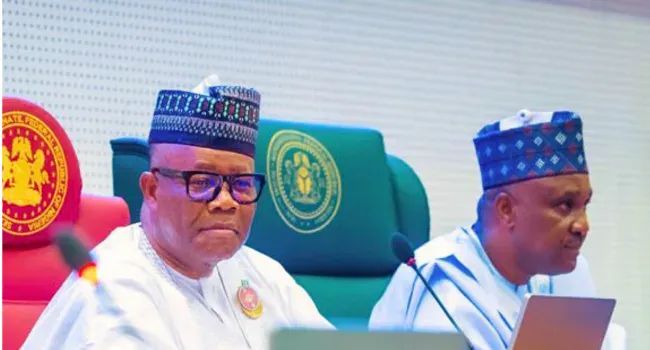
In a letter dated June 27, 2026, addressed to Senate President Godswill Akpabio and Speaker of the House of Representatives Tajudeen Abbas, the civic organisation called for immediate action on findings contained in the 2022 Annual Report of the Auditor-General of the Federation.
SERAP, in a statement issued on Sunday by its Deputy Director, Kolawole Oluwadare, also demanded the disclosure of the identities of contractors, companies, their shareholders and beneficial owners allegedly linked to constituency projects that were either abandoned or not executed despite receiving public funds.
The organisation warned that it would seek legal redress if the National Assembly failed to act within seven days.
“We would be grateful if the recommended measures are taken within seven days of the receipt and/or publication of this letter. If we have not heard from you by then, SERAP shall take all appropriate legal actions to compel you and the National Assembly to comply with our request in the public interest,” the letter stated.
According to SERAP, the Auditor-General’s report identified alleged financial irregularities across several federal ministries, departments and agencies, including the Environmental Health Registration Council of Nigeria, the Federal College of Animal Health and Production Technology, Vom, the Federal Polytechnic, Ukana, the National Agency for the Prohibition of Trafficking in Persons, and the National Institute of Legislative and Democratic Studies.
The group alleged that the report highlighted cases involving payments into private bank accounts, contracts awarded without due process, payments for projects that were not executed, undocumented expenditures, inflated contracts and other procurement violations.
“The Auditor-General identified numerous cases of payments into private bank accounts, contracts awarded without due process, payments for contracts not executed or services not rendered, undocumented expenditures, inflated contracts, procurement irregularities and failures to account for public funds,” SERAP said.
Among the cases cited, SERAP alleged that the Environmental Health Registration Council of Nigeria made questionable payments exceeding ₦1.8 billion from constituency project funds, including over ₦22 million reportedly transferred into private staff accounts without evidence of how the money was utilised.
The organisation also alleged that the Federal College of Animal Health and Production Technology, Vom, made hundreds of millions of naira in undocumented payments to contractors for youth and women empowerment programmes, while the Federal Polytechnic, Ukana, was linked to alleged mobilisation payments, inflated contracts and projects that were either poorly executed or not executed at all.
It further claimed that the report raised concerns over contract awards and payments by NAPTIP, as well as financial management lapses at NILDS, including the non-submission of audited financial statements for several years.
SERAP argued that if established, the alleged infractions would constitute violations of constitutional provisions, the Fiscal Responsibility Act and the Public Procurement Act.
The organisation maintained that effective oversight by the National Assembly was necessary to ensure accountability and transparency in the management of constituency project funds, stressing that public resources meant for development should not be diverted at the expense of Nigerians.