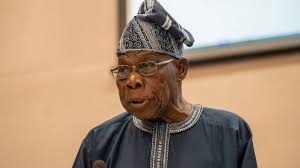
Former President Olusegun Obasanjo has revealed why he developed deep admiration for entertainer Charles Oputa, despite initially disapproving of his unconventional appearance and lifestyle.
Speaking during an interview on the Before Tomorrow Comes Podcast shared on YouTube, Obasanjo recounted how his long relationship with the Oputa family changed his perception of the entertainer.
The former military head of state said he was a close friend of Charlie Boy’s late father, Justice Chukwudifu Oputa, whom he described as one of the few Nigerians he truly admired.
“I was close to Charlie Boy’s father, Justice Oputa. I don’t have many friends or many people that I would say I admire, but late Justice Oputa was one Nigerian I could call a friend and one Nigerian I admired,” Obasanjo said.
He admitted that his first impression of Charlie Boy was negative because of the entertainer’s eccentric dressing style.
“Then I started seeing Charlie Boy, and they say Charlie Boy is the son of Justice Oputa. Justice Oputa is decent, well-groomed, well-dressed, immaculate, and proud. And then I saw this man called Charlie Boy, Oputa’s son.
“He was dressed jaga-jaga. I said, ‘Look, how can an adult dress like this?’ So I didn’t think much of Charlie Boy,” he stated.
Obasanjo explained that his opinion changed after visiting Justice Oputa and discovering the retired jurist staying at Charlie Boy’s residence.
“On one occasion, I wanted to pay him a visit. And where did I find him? I found him in Charlie Boy’s house,” he recalled.
According to him, what impressed him most was the way Charlie Boy cared for his father.
“What struck me was Charlie Boy’s way of taking care of his father. If Charlie Boy had been ten times immaculately dressed, he would not have taken care of his father better than I saw him taking care of him,” Obasanjo said.
The former president added that he later realised Charlie Boy’s dramatic appearance and behaviour were part of his entertainment brand.
“I realised that Charlie Boy’s jaga-jaga tricks, his mediated acts of being a comedian and making money out of the way he dressed and behaved, were all part of comedy and amusement,” he added.
Obasanjo further disclosed that he became close to Charlie Boy’s mother, whom he described as “a moral woman,” noting that the entertainer also took exceptional care of her before her death.
Reflecting on the relationship between Charlie Boy and his late father, Obasanjo said parents should guide their children while allowing them to pursue lawful paths that align with their passions.
“If he would not be a lawyer, but definitely be a singer or a comedian, it was not what the father would want. But he decided to choose a path for his life and maintained it,” he said.
The former president also praised Charlie Boy’s memoir, 999, describing it as “fairly well written,” “fairly well produced,” and “a masterpiece” containing lessons on resilience, family values, and philanthropy.
The memoir is scheduled for public presentation on July 31 at the Mike Adenuga Centre in Lagos.
Obasanjo also used the interview to preach tolerance and national unity, cautioning Nigerians against stereotyping ethnic groups based on the actions of individuals.
“If you say the Yorubas are bad because of what one Yoruba man had done, or the Fulanis are bad because of what one Fulani man had done, then who’s good?” he asked.