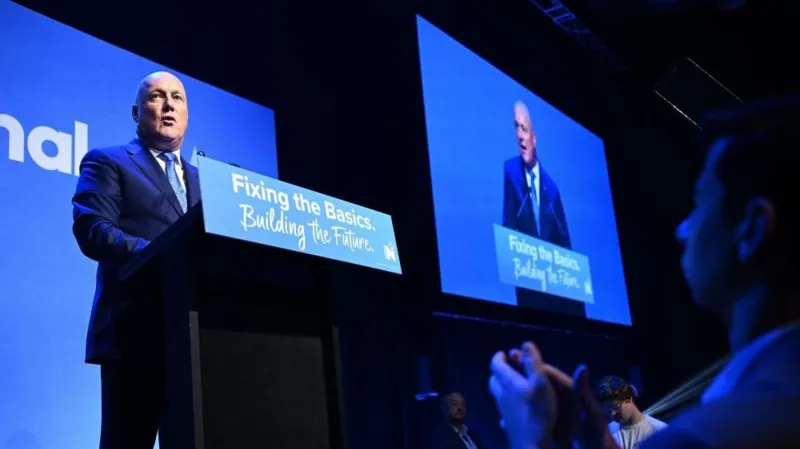
New Zealand’s general election has produced no clear winner, with Prime Minister Christopher Luxon’s National Party and opposition Labour Party preparing for coalition talks after a closely contested poll.
Prime Minister Christopher Luxon’s centre-right National Party secured 42 seats, making it the largest party in parliament, but fell 19 seats short of the majority required to form a government, according to preliminary results.
Its potential coalition with ACT and New Zealand First could give the bloc a slim advantage over the left-leaning opposition.
Opposition leader Chris Hipkins’ Labour Party won 36 seats but showed no indication of conceding defeat.
Hipkins said the “shape of the next government” would remain uncertain “for a while”, following an election campaign dominated by the cost of living and unemployment.
The preliminary projections placed the Green Party on 16 seats, ACT on 13, New Zealand First on 12, the Opportunity Party on seven and Te Pāti Māori, which represents Māori interests, on five. More than 99 per cent of votes had been counted, with National and Labour recording nearly identical vote shares.
Their combined support was estimated at around 60 per cent, reflecting historically low backing for the two dominant parties.
Luxon congratulated Hipkins on a “very hard-fought race” before addressing National Party supporters in Auckland.
He said, “whatever the final count, we are incredibly proud of each and everyone for you”.
The prime minister also announced that he would lead a caretaker government until the official results were confirmed, adding, “With those final results there can then be meaningful negotiations.”
Hipkins, meanwhile, said “the people have spoken”, adding: “It may take a bit longer to work out what they’ve said.”
He noted that the election outcome would require cooperation among political parties, saying, “the next parliament is going to require all of us to compromise, to work together and to find a common ground”.
The Opportunity Party emerged as a potential kingmaker after crossing the five per cent threshold to enter parliament for the first time.
Its leader, Qiulae Wong, said the party was open to working with either major bloc but would first negotiate with the party that secured the most seats.
“We believe that we can change the way we do politics to focus on the future, on the next generation, and on finding common ground,” she said.
Professor Andrew Geddis of the University of Otago, an election law expert, described the Opportunity Party as a wildcard that could determine which bloc forms the next government.
He said, “It will come down to some very fine vote margins not just between the parties, but in individual electorates. We are going to have to wait for the special votes to be processed and counted over the next three weeks.”
The official election result is expected to be announced by the electoral commission on November 27.
New Zealand operates a mixed-member proportional voting system, under which voters choose both a constituency representative and a political party, making coalition governments common.