

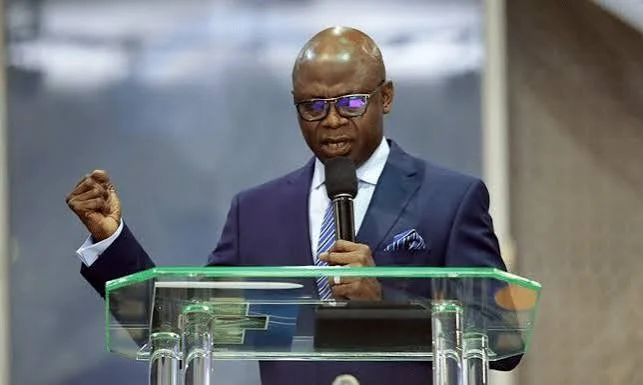
Serving Overseer of the Citadel Global Community Church, Pastor Tunde Bakare, has urged Nigeria’s leaders to confront the nation’s institutional shortcomings, warning that meaningful development will remain out of reach unless governance is built on strong institutions, continuity and responsible leadership.
The Punch reported that Bakare made the remarks on Sunday in Lagos during the public presentation of his three-volume publication, Strategic Intervention in Governance, a collection documenting nearly two decades of his contributions to debates on governance and national development.
The former presidential candidate argued that replacing political office holders alone would not resolve Nigeria’s persistent challenges, insisting that the country needed leaders willing to tackle difficult issues while establishing institutions capable of sustaining progress beyond their time in office.
“Nation-building is impossible without leadership continuity. Vision without succession eventually dies,” Bakare said.
The three-volume work compiles 104 speeches delivered between 2008 and 2025 under five different presidential administrations.
The speeches focus on governance, constitutional reform, corruption, leadership, public accountability and national development.
The unveiling attracted leading personalities from politics, academia, law, religion and civil society, including former Akwa Ibom State Governor Victor Attah, former Ekiti State Governor Dr Kayode Fayemi, former Ogun State Governor Segun Osoba, former Minister of Health Olorunnimbe Mamora, Pastor Jimi Odukoya of Fountain of Life Church, human rights activist Dr Joe Okei-Odumakin, Prof Akin Oyebode and the Vice-Chancellor of the University of Lagos, Prof Folasade Ogunshola.
Reviewing the publication, Elder Olabode Adekanye described it as a record of Bakare’s 18-year engagement with Nigeria’s governance landscape, tracing his transition from criticising governments to advocating institutions capable of addressing the country’s recurring problems.
He characterised the collection as “the voice that challenged a nation,” saying it should be regarded not merely as a compilation of speeches but as a sustained reflection on the obligations of both leaders and citizens.
According to Adekanye, the trilogy challenges Nigerians to move beyond identifying national problems and begin taking responsibility for solving them.
The three books cover different periods of Bakare’s public interventions.
The first contains 36 speeches delivered between 2008 and 2015, the second features 31 speeches from 2015 to 2018, while the third includes 37 speeches delivered between 2019 and 2025.
Adekanye noted that the speeches were presented in churches, universities, civic forums, press conferences, protest grounds, business gatherings and political events, demonstrating that public engagement should not be left solely to politicians.
“Strategic Intervention in Governance is not a book about politics. It is a book about the cost of silence, and the price a nation pays when its conscience stays in the church and never enters the chambers of power,” he said.
The publication also chronicles Bakare’s activism from his student days at the University of Lagos, highlighting his opposition to military rule, resistance to the annulment of the June 12, 1993 presidential election, detention under the late Gen Sani Abacha’s regime and participation in the Save Nigeria Group protests during the 2010 constitutional crisis following President Umaru Yar’Adua’s prolonged absence from office.
The review portrays Bakare as an active participant in Nigeria’s political evolution rather than a distant observer, noting that his interventions frequently brought him into conflict with those in authority.
It recalls his opposition to the annulment of the June 12 election during the regime of Gen Ibrahim Babangida and his detention in 1997 under Abacha.
The review also states that under civilian rule, Bakare’s criticism of former President Olusegun Obasanjo’s administration led to his detention and the confiscation of his passport in 2002.
His involvement in the Save Nigeria Group campaign during the Yar’Adua constitutional crisis, it added, reflected his belief that citizens and institutions must act whenever governance fails.
The first volume focuses largely on the legitimacy of political authority, including Bakare’s comparison of government to a bank entrusted with power deposited by citizens through their consent, underscoring that political authority is borrowed rather than permanently owned.
It also examines the 2012 fuel subsidy protests and Nigeria’s 2014 National Conference, contrasting the conference with the 1787 Philadelphia Convention that produced the United States Constitution.
According to the review, Bakare argued that Nigeria had repeatedly organised national conferences without resolving the constitutional issues at the heart of its political system.
The second volume shifts attention to institutional weaknesses and the relationship between leadership and citizenship.
It argues that institutions can only be as strong as the individuals who manage them and that constitutional amendments alone cannot transform society without corresponding changes in citizens’ values and conduct.
Bakare also examines the role of the Christian church, questioning whether religious institutions had become contributors to the societal dysfunction they often condemn.
Adekanye said this readiness to scrutinise his own constituency strengthened the credibility of Bakare’s wider criticism of political leadership.
The third volume marks what the reviewer described as a transition from criticism to institution-building.
It traces Bakare’s movement from what Adekanye called “prophetic protest” to “institutional renewal,” highlighting the establishment of the Citadel School of Government and its partnership with the University of Lagos Business School as efforts to move beyond diagnosing governance failures towards building practical solutions.
According to Adekanye, the trilogy ultimately challenges Nigerians to determine whether they are prepared to create the institutions required to solve the nation’s problems.
“The diagnosis alone is not enough; one must become part of the remedy,” Adekanye said in the review.
He said the publication maintains a consistent message despite changes in administrations and political circumstances, identifying three defining features: Bakare’s ability to combine religious and empirical arguments, his willingness to question his own positions and his commitment to confronting institutional and political failures.
The reviewer added that the trilogy avoids descending into cynicism, choosing instead to explore whether Nigeria can still be rebuilt and what role citizens must play in achieving that goal.
Bakare, who served as the running mate to the late former President Muhammadu Buhari in the 2011 presidential election on the platform of the Congress for Progressive Change, said the books were written to offer practical ideas for addressing Nigeria’s challenges rather than merely criticising those responsible.
He also urged leaders to govern with compassion while encouraging young Nigerians to create opportunities for themselves and contribute to national development despite institutional shortcomings.
The cleric maintained that Nigeria’s future depended on citizens prepared to make sacrifices for the nation.
Chairman of the event and former Ogun State Governor, Segun Osoba, endorsed Bakare’s message, describing him as a committed patriot whose interventions had always been driven by national interest rather than personal gain.
“When you see Bakare fighting for the nation, it is not for self,” Osoba said.
Osoba added that Bakare’s significance lay not only in criticising those in power but also in presenting practical alternatives.
He urged Nigerians who fault President Bola Tinubu and other public officials to equally put forward workable solutions.
“Bakare’s book is not just to criticise but to proffer solutions to the nation’s challenges,” Osoba said.
Also speaking, the senator representing Ogun West and the All Progressives Congress governorship candidate for Ogun State, Solomon Adeola, urged political leaders to improve the welfare of citizens while calling on Nigerians to embrace patriotism and a stronger sense of national identity.
Bakare announced that copies of the publication would be donated to universities nationwide, including the University of Lagos, where he studied law.


