

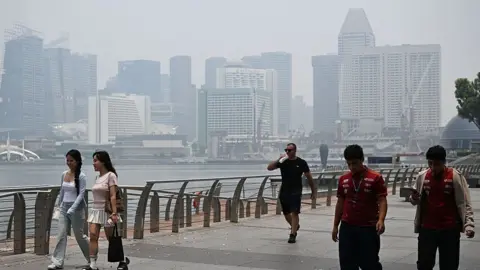
Singapore recorded its highest air pollution levels of the year on Wednesday, while East Timor ordered schools to suspend in-person classes for three days as smoke and haze from wildfires in neighbouring Indonesia spread across Southeast Asia.
The pollution reading for fine particulate matter (PM2.5) reached 284 micrograms per cubic metre in western Singapore, entering the National Environment Agency’s “very high” category for the first time during the current haze period.
East Timor announced that face-to-face learning would be suspended from October 15 for three days because of pollution from wildfires in neighbouring areas and countries.
In a statement, the government said the decision was taken “due to contamination by pollutant particles from wildfires in neighbouring regions or countries”.
Although the government did not specifically name Indonesia, East Timor shares an island with part of Indonesia’s East Nusa Tenggara province, where several wildfire hotspots have been reported.
Indonesia is experiencing its most intense wildfire season in 11 years, with El Niño-related dry conditions contributing to the spread of the fires.
The resulting haze has worsened air quality across the region and increased respiratory illnesses in affected areas.
Several states in Malaysia have also been forced to close schools because of the pollution.
The situation has revived memories of October 2015, when Indonesian wildfires pushed PM2.5 levels in western Singapore to a national record of 471 micrograms per cubic metre.
Indonesian authorities have intensified efforts to contain the fires following an order by President Prabowo Subianto for additional firefighting resources to be deployed.
Speaking at a briefing on Wednesday, Honi Havana, an official at the Coordinating Ministry for Political and Security Affairs, said, “We are mobilising all our resources and capabilities.”
He disclosed that the number of firefighting personnel deployed across the country had increased to more than 69,000 from approximately 44,000 in mid-September.
Authorities are also testing specialised chemicals and other methods to improve firefighting operations.
However, disaster mitigation agency spokesperson Berton Panjaitan said peatland fires remained a major challenge because they could continue burning beneath the ground and flare up again.
“We must recognise that the only way to resolve this is through sustained rainfall,” he said.
Indonesia’s health situation has also deteriorated amid the worsening haze. Respiratory illness cases across seven provinces had risen to 283,270 as of October 13.
Meanwhile, criticism of Jakarta’s handling of the wildfires has grown across Southeast Asia ahead of an Association of Southeast Asian Nations meeting scheduled for next month, where foreign ministers are expected to discuss transboundary haze.
On Tuesday, Malaysian lawmaker Syed Saddiq Syed Abdul Rahman urged Southeast Asian countries to jointly protest against Indonesia over what he described as inadequate efforts to control the fires.
“We must send a strong diplomatic note that Malaysia objects, and that not only Malaysia objects, it must be agreed upon by other ASEAN countries that are similarly affected, such as Singapore. We must send a very clear diplomatic protest,” he told parliament.
He also called for stronger regional action against companies linked to land burning, saying, “You need to treat them like an outcast in the region.”
The lawmaker further proposed that Malaysian and Singaporean banks stop financing companies associated with the burning of land.


