

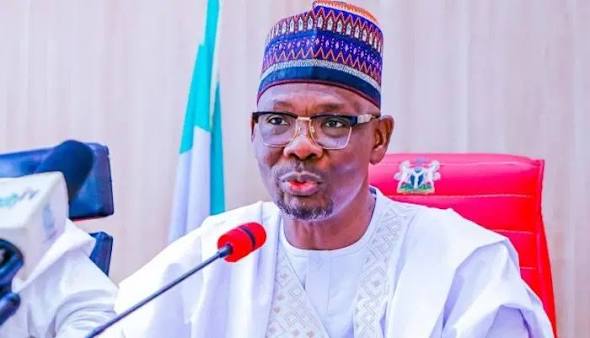
Nasarawa State Governor, Abdullahi Sule, has expressed hope that Nigeria will one day elect a presidential ticket comprising two Christians, saying he would like to see such a ticket succeed at the polls.
Sule made the statement on Tuesday while appearing on Channels Television’s Politics Today, where he reacted to concerns over the possibility of another same-faith presidential ticket ahead of the 2027 general elections.
The governor was responding to comments by the Nigeria Democratic Congress vice-presidential candidate, Rabiu Kwankwaso, regarding the possibility of the ruling All Progressives Congress fielding another Muslim-Muslim ticket.
Sule defended the APC’s previous Muslim-Muslim ticket, rejecting claims that the arrangement was designed to exclude Christians from political leadership.
He said Nigeria should also have the opportunity to test the electoral prospects of a Christian-Christian ticket.
“I pray that one day Nigeria will have a Christian-Christian ticket, and it will win. That’s what I pray to see,” Sule said.
The governor recalled the 1993 presidential election, in which the late Chief Moshood Abiola and his running mate, Babagana Kingibe, contested on a Muslim-Muslim ticket.
He maintained that previous Muslim-Muslim presidential pairings had demonstrated that such arrangements could win elections.
“You can see both elections have been clear that the Muslim-Muslim ticket has won,” he said.
Sule said Kwankwaso’s criticism of the APC’s ticket was understandable because he was an opposition politician.
He added that he did not expect members of the opposition to praise the ruling party’s political decisions.
“I think it is normal for Senator Kwankwaso, who I respect a lot, to say that because he’s opposition. He cannot say anything good in that manner. So when he said that, it is expected of him to say that,” he said.
The Nasarawa governor argued that the Nigerian Constitution emphasises inclusiveness and equitable representation rather than religious balancing.
According to him, Section 14(3) of the Constitution provides for inclusiveness and representation of all parts of the country, while Section 15 addresses the principle of federal character and ethnicity.
“It all actually happens in Section 14(3) of the constitution, where it’s talking about making sure that there is inclusiveness, there is representation, and all parts of the country, none of them is neglected, none of them is not carried along,” he said.
Sule added, “That’s where federal character came in, following Section 15 of the same constitution that also talks about ethnicity. There is no place where it talks about religion. Section 14 didn’t talk about religion. Section 15 didn’t talk about religion.”
Asked whether he had a Christian as his deputy, Sule said his deputy, Emmanuel Akabe, had remained in office throughout his tenure.
“I’ve always had a Christian as a deputy. In Nasarawa State, it has always been a Christian,” the governor said.
He, however, explained that Akabe’s selection was primarily based on competence rather than an attempt to achieve religious balance.
Sule said political arrangements differed across states, depending on their individual circumstances.
“No, no, no, we thought it was important because Emmanuel Akabe is competent. Our state is different from Nigeria. You cannot take a particular state,” he said.
The governor cited Enugu and Bayelsa as examples of states where Christian-Christian political arrangements exist.
“Take Enugu, for instance, it has a Christian-Christian arrangement. Take Bayelsa, it’s Christian-Christian,” he added.


