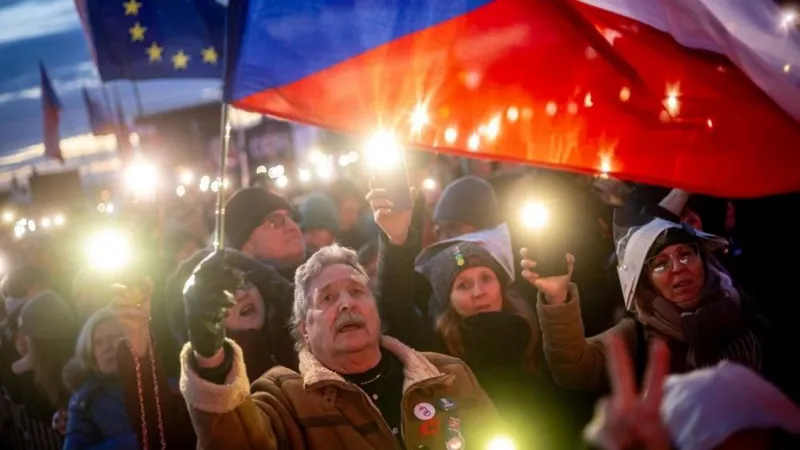
Thousands of people have protested in Prague, Czech Republic, against the government’s proposed abolition of licence fees for public broadcasters, amid fears that the move could undermine media independence.
The demonstration, held in the capital on Sunday, was organised by Million Moments for Democracy, which estimated that approximately 400,000 people participated in the rally.
The proposed reform seeks to replace the current licence fee system with funding from the national budget.
Critics of the plan argue that the arrangement could give politicians greater influence over public broadcasting and threaten editorial freedom.
Czech households currently pay 205 crowns, equivalent to $9.44 or £7.06, monthly for public television and radio services.
Parliament passed the first draft of the proposal late last month, triggering protests across the country.
A 72-year-old pensioner, Milana Rudolfova, told Reuters that she regarded Czech Television as a reliable source of information.
“I know that our entire Czech Television is a guarantee of truth and objectivity,” she said.
“If we do not have public television and radio then unfortunately we will not be able to believe anything anymore.”
However, Prime Minister Andrej Babis has defended the proposed changes, insisting that the government has no intention of interfering with the operations of public broadcasters.
“The funding system is changing, no one wants to control public media, no one wants to dictate to them what they should say and do, no one wants to nationalise them,” Babis told the Czech News Agency.
“We are doing this because the system is already outdated and most of Europe is going the same way today and others are joining in,” he added.
The proposed reform is expected to result in a 15 per cent reduction in funding for Czech Television and Czech Radio, according to Reuters.
Some European countries have already abandoned the traditional licence fee model.
France scrapped its broadcasting licence fee in 2022 and now funds public media through a portion of its value-added tax revenue, while Norway ended its licence fee in 2020 and transferred public broadcasting funding to the national budget.
Protesters also expressed concern that the Czech government’s proposal could mirror developments in Hungary under former Prime Minister Viktor Orbán, whose administration faced criticism over its control of state media.
Babis, who was appointed prime minister in December 2025, has also faced criticism over his coalition government’s approach to the media.
Pavol Szalai, Prague Bureau director of Reporters Without Borders, said in June that attacks on media organisations had become a defining feature of Babis’ leadership.
“Political attacks against private and public media have become one of the hallmarks of Andrej Babis’ premiership,” he said.