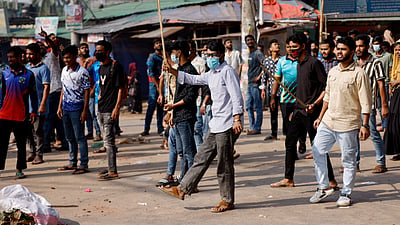
Garment workers in Bangladesh have staged fresh protests after the government approved a 36 per cent increase in their minimum wage, rejecting the new rate as inadequate despite weeks of industrial unrest and demands for higher pay.
The decision, announced on Wednesday, raises the monthly minimum wage to 17,000 taka ($138) from the existing 12,500 taka ($101).
However, the increase has failed to satisfy workers who had demanded 32,000 taka ($257) before reducing their request to 18,000 taka during negotiations.
The new wage structure was approved by a six-member government-appointed panel following nearly 12 hours of negotiations that ended around 2am on Wednesday.
Four members supported the 17,000 taka proposal, while two backed the workers’ demand of 18,000 taka, according to workers’ representative Babul Akhter.
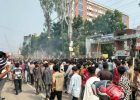
The disagreement triggered fresh confrontations between workers and security personnel in Gazipur, a major garment manufacturing hub on the outskirts of Dhaka, Bangladesh’s capital.
Police reportedly fired tear gas and sound grenades to disperse protesters who blocked a major highway.
Under the revised four-grade wage structure, monthly salaries will range from 17,000 taka for Grade 4 workers to 21,500 taka for Grade 1 employees.
The new rates will take effect on December 1, with workers expected to receive their increased salaries from January.
Labour rights advocates have criticised the adjustment, describing it as insufficient to provide workers with a decent standard of living.
The 36 per cent increase is the smallest percentage rise since Bangladesh introduced a minimum wage for garment workers in 1986.
Previous increases included 56 per cent in 2023, 51 per cent in 2018 and 77 per cent in 2013.
“These negotiations result in poverty wages time and time again,” said Anne Bienias, the Clean Clothes Campaign’s living-wage coordinator, adding that the new pay rate remained well below a living-wage level.
The garment industry is a major pillar of Bangladesh’s economy, employing more than four million people and accounting for over 80 per cent of the country’s export earnings.
Major international retailers, including H&M, Zara, Walmart, Target and Gap, source products from factories in the country.
The prolonged wage dispute has also affected production and exports.
The Bangladesh Garment Manufacturers and Exporters Association said 397 factories could not operate on Tuesday, while another 84 remained closed under the labour law’s ‘no work, no pay’ provision.
A survey by the association estimated that 317 factories lost about $428m in production during 18 days of disruption, while international buyers transferred orders worth approximately $254m to other countries.
Industry operators have also expressed concerns that the increased wages could weaken Bangladesh’s competitiveness against other garment-producing countries, particularly as manufacturers face rising production costs.
“At $138, we now pay more than West Bengal in India and about the same as Vietnam, Indonesia and Pakistan. Low cost was our main edge, and it’s gone,” said Mohiuddin Rubel, additional managing director of Denim Expert Ltd, which supplies international brands, including H&M.
He argued that improving production capacity through automation, skills development, affordable long-term financing and faster port and customs clearance would be necessary for the country to remain competitive.
Rubel also called on international clothing brands to share the additional labour costs with manufacturers, warning that smaller factories might struggle to accommodate the new wage structure.
“Buyers are our partners and the biggest stakeholders, so sharing the higher wage cost is their responsibility too,” he said.
“We have already cut prices by 6.54% in Europe so far this year and still lost volume, and small factories cannot absorb the new wage bill alone. Brands should ring-fence the wage cost in their prices.”