At least 490,334 Russian soldiers have died since the country launched its full-scale invasion of Ukraine in February 2022, according to an analysis of leaked Russian government statistics by the British Broadcasting Corporation.
The investigation by BBC Russian examined more than 11 million death records covering January 2021 to September 2026, revealing the devastating human cost of the war, which has lasted almost five years.
The records were obtained following cyberattacks by Belarusian group Cyber Partisans BY and Ukraine’s Silent Crow.
Although Russia’s statistics agency, Rosstat, acknowledged the cyberattack, it denied that protected information had been leaked.
Working with independent Russian outlet Mediazona, BBC Russian compared the data with its independently compiled list of confirmed military deaths and found matches for 90 per cent of the records.
The analysis showed that the war has particularly affected younger Russian men.
In 2025, 65 per cent of Russian men aged 18 to 24 who died were killed in the conflict, while the figure was 59 per cent among those aged 25 to 34.
The investigation also revealed the scale of casualties during battles for relatively small Ukrainian settlements.
About 20,000 Russian soldiers reportedly died fighting for 10 villages with a combined pre-war population of 12,000.
In Andriivka, a village south of Bakhmut in Ukraine’s Donetsk region, 1,122 Russian soldiers were killed during the fighting. The settlement had just 74 residents before the war.
Russia has not publicly disclosed its overall military death toll since the invasion began.
It also stopped publishing detailed statistics on deaths from external causes two years ago.
To establish its estimate, BBC Russian filtered the Rosstat records by location and circumstances of death.
It identified 425,174 entries explicitly linked to military-related causes, including explosions and shrapnel injuries.
The investigators also identified deaths through employment records and court rulings, which are often issued when soldiers have been missing in combat zones for more than six months without their bodies being recovered.
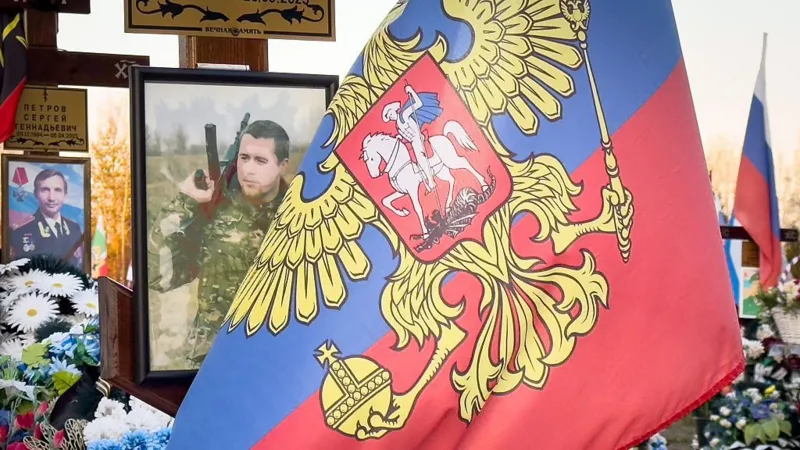
Separately, BBC Russian and Mediazona have independently verified 290,012 Russian military deaths using official announcements, social media posts, memorials and burial records.
However, the actual figure is believed to be considerably higher because many deaths are not publicly reported.
The investigation found that the average age of Russian soldiers killed increased from 34 in the first year of the war to 40 in 2025, as prisoners and contract soldiers joined the military.
Some of Russia’s poorest regions have suffered disproportionately. Men from Tyva, Buryatia and Zabaykalsky Krai were found to be 20 to 25 times more likely to die in the war than residents of Moscow and St Petersburg.
The leaked records also identified at least 5,017 foreign nationals killed while fighting for Russia, including 1,031 Uzbeks and 720 Tajiks.
The figure excludes Ukrainians and may not account for dual nationals classified as Russians.
North Korean casualties were also absent from the database.
However, BBC Russian separately identified 2,304 North Korean soldiers killed while helping Russian forces repel a Ukrainian incursion in 2024, using satellite imagery and official photographs of a memorial in Pyongyang.
Military experts estimate that the 290,012 deaths independently confirmed by the BBC could represent between 45 and 55 per cent of Russia’s actual military fatalities, putting the possible death toll between 527,295 and 644,471.
The scale of the losses is significant compared with the Soviet Union’s war in Afghanistan, which ended in 1989.
Meanwhile, Ukrainian President Volodymyr Zelensky put his country’s military deaths at approximately 50,000 in July 2026, while an independent count by the anonymous UA Losses website estimated the figure at 115,952.
This version removes some of the technical details of the data filtering while retaining the methodology needed to understand how the BBC arrived at its estimate.